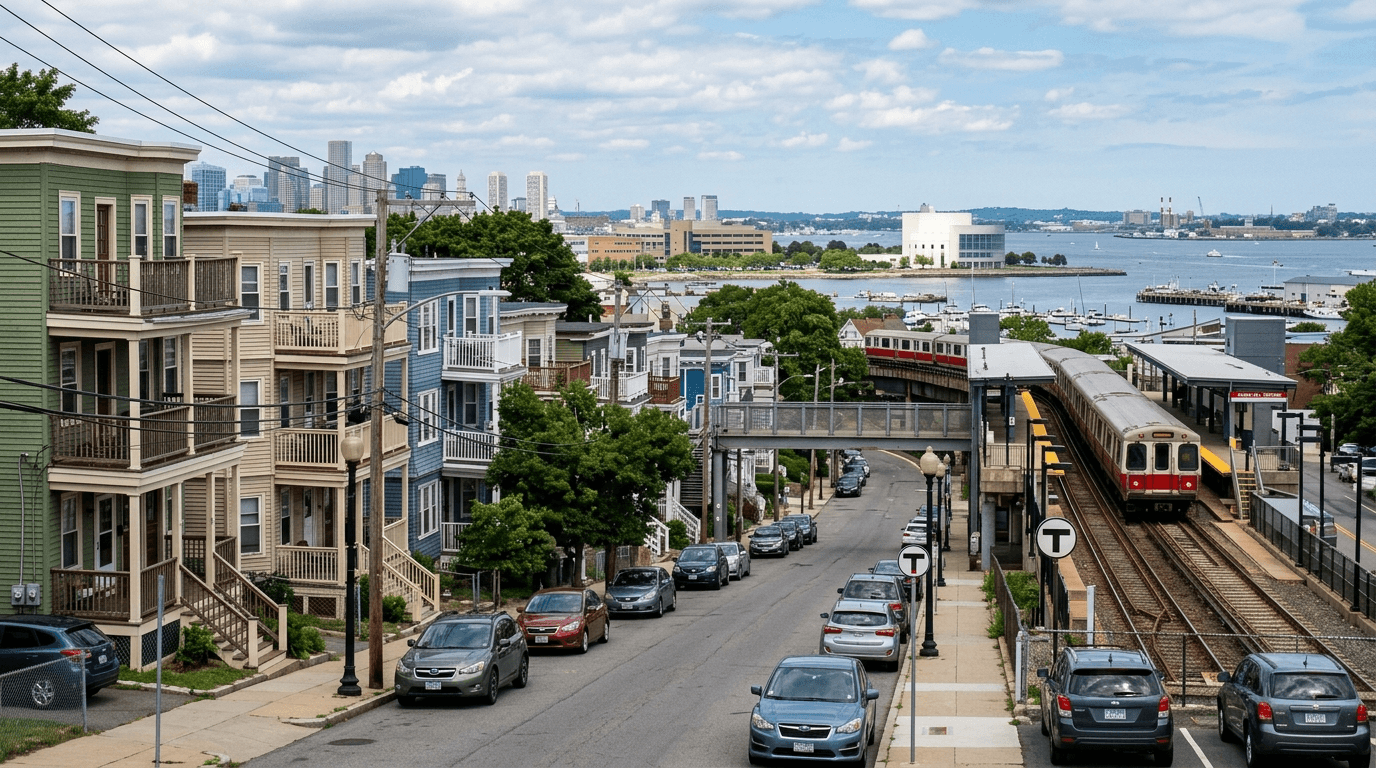
The Essential Guide to Living in Fenway-Kenmore: Urban Energy, Transit Access, and Modern Condo Life
Explore Fenway-Kenmore’s high-energy vibe: 31,374 residents, 90/100 transit, Green Line access, Fenway Park, Longwood, and condo prices.
Written ByAndrew Schwartz
PublishedSeptember 9, 2026
We're SmartHub Boston, a data-driven brokerage led by Andrew Schwartz serving buyers, sellers, investors and landlords across Boston, Cambridge, Newton and Brookline. Serving Boston, Newton, Brookline, Cambridge, Somerville, Watertown, Natick, Wellesley and Weston, MA.
# Fenway-Kenmore Neighborhood Guide: Urban Energy and Modern Condo Living
Fenway-Kenmore is Boston at its most unapologetically urban. Just over one square mile, roughly 31,374 residents, a ballpark, two world-class museums, and one of the densest concentrations of graduate students, medical researchers, and early-career professionals anywhere in the country. If a car-optional life within a 15-minute walk of your lab, office, or gym sounds appealing, this belongs on your shortlist. If you're after quiet, keep looking.
Here's what to know before you tour.
What is the vibe like in Fenway-Kenmore, and is it good for young professionals?
Short answer: Fenway-Kenmore is loud, dense, and genuinely energizing — and it's arguably the best-matched Boston neighborhood for renters and first-time buyers in their 20s and early 30s. Nearly six in ten residents are between 18 and 24, and roughly 75% of adults hold a bachelor's degree. You will not be the only person on your floor who works in biotech.
Three overlapping economies power the place: the university corridor (BU, Northeastern, Berklee, Simmons, Emmanuel), the Longwood Medical Area just to the south, and the newer wave of tech and life-sciences office space along Boylston Street and Brookline Avenue. That mix explains a lot — why weekday mornings on the Green Line platform look like a career fair, and why the restaurant scene leans toward fast-casual lunch and serious cocktails rather than family booths.
Fenway vs. Boston Age Profile
Fenway skews dramatically younger than Boston overall, with a major concentration of residents ages 18–24 and 25–34—one reason the neighborhood feels lively, dense, and student/professional-oriented.
Fenway
Boston
Fenway skews dramatically younger than Boston overall, with a major concentration of residents ages 18–24 and 25–34—one reason the neighborhood feels lively, dense, and student/professional-oriented.
If a prospective buyer looks at only one chart, make it that one. Fenway skews dramatically younger than Boston overall — 59% of residents fall in the 18–24 bracket versus 15% citywide, with another 20% in the 25–34 range. In practice, that means three things:
•Turnover is constant. September 1 is the neighborhood's real New Year. Expect moving trucks, and expect the rental market to reset annually.
•Social barriers are low. Nobody's been here 30 years. Newcomers integrate fast.
•Noise is a real variable. Fenway-Kenmore's Sound Score comes in at 63/100 — mid-range, but that average hides enormous block-by-block variation.
Let me be specific about the noise, because this is where I spend the most time coaching buyers. There are 81 Red Sox home games a season. A condo on Lansdowne Street or the Kenmore Square side of Commonwealth Ave lives inside that energy: crowds, ambient sound, a genuine street festival roughly half the summer nights. A unit on Peterborough Street, on Jersey Street south of Boylston, or facing the Back Bay Fens is a materially quieter home in the same ZIP code. Tour the same building twice — once on a weekday afternoon, once during a game or a House of Blues show — and you'll learn more than any listing sheet will tell you.
The counterweight to all that intensity is the Fens. Frederick Law Olmsted's Emerald Necklace runs straight through the neighborhood, and the Back Bay Fens gives residents community gardens, ballfields, the Kelleher Rose Garden, and a genuinely peaceful running loop. City pathway improvements began in 2025, with phase two construction slated across 2026 and 2027 — short-term disruption, long-term upgrade. It's a 12-minute walk from Kenmore Square, and it's the reason people who've been here five years describe the neighborhood as balanced rather than simply busy.
What are condos and townhomes like in Fenway-Kenmore, and what do they cost?
Direct answer: this is a condo-and-apartment market, full stop. You'll find brick bowfront brownstones from the early 1900s converted into two- to six-unit associations, mid-century elevator buildings, and a new generation of glass-and-steel luxury towers — but almost no single-family homes and effectively no meaningful private lot.
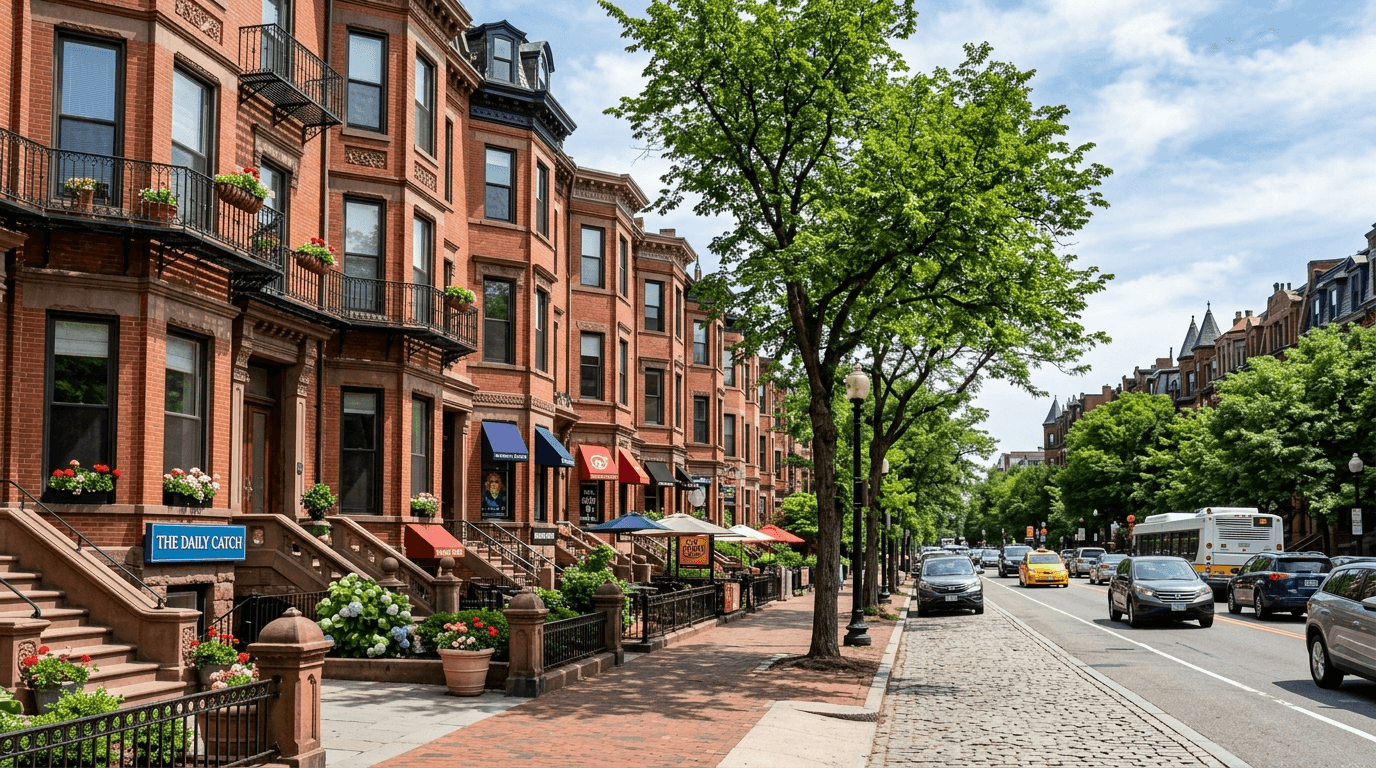
The neighborhood's median construction year is 1946, a number that captures the split personality of the housing stock perfectly. The historic layer is turn-of-the-century masonry: brick and brownstone bowfronts along Peterborough Street, Queensberry Street, Beacon Street, and Bay State Road, most of them four to six stories, most converted to condos or co-ops decades ago. Units run small and efficient — a typical one-bedroom averages around 600 square feet — but you get original details like bay windows, decorative fireplaces, and hardwood that new construction simply doesn't replicate.
The modern layer has reshaped the neighborhood over the last fifteen years. The Fenway Triangle and the Boylston Street corridor now hold high-rise developments with concierge desks, common roof decks, fitness centers, and package rooms. A heavy run of BPDA-approved housing in the Fenway over the past decade is why the neighborhood feels newer than its median build year suggests.
What do properties actually sell for in Fenway-Kenmore?
Fenway-Kenmore is a genuine million-dollar-plus condo market, which surprises buyers who assume "student neighborhood" means cheap.
Fenway-Kenmore 2026 Market Snapshot
Headline pricing and competitiveness metrics for young professionals weighing a Fenway-Kenmore move: high median sale price, quick market pace, and a transit-heavy urban lifestyle baseline.
Here's how I'd read that snapshot with a client — noting up front that these are Redfin's neighborhood-tracker figures, not MLS-verified numbers:
•Price growth is real. Redfin's Fenway-Kenmore tracker shows a +8.7% year-over-year move in median sale price, against a median of $1,149,608 across 324 sales. Strong, yes. But the mix of what sells here shifts constantly between compact one-bedrooms and larger high-end units, so don't assume your specific unit type appreciated at the headline rate.
•Negotiation room exists. Per that same Redfin data, a 98.5% sale-to-list ratio and 30.9% of homes taking a price drop tells you this isn't a bidding-war market across the board. Well-priced, well-renovated units still move fast. Overpriced inventory sits.
•Pace is brisk, not panicked. Redfin puts median days on market at 28, which means good product doesn't linger.
By unit type, standard one-bedrooms generally trade below the neighborhood median, luxury one-bedrooms in buildings like Pierce Boston push meaningfully higher, and two- and three-bedroom inventory climbs into the multi-million-dollar trophy tier. There's a value floor, too: some sales in older elevator buildings close well under the median, and Kenmore Tower — a 111-unit, 13-story 1968 building — currently shows listings from $449,999 to $1,300,000.
What do HOA fees typically look like in Fenway-Kenmore condos?
This is the question buyers underestimate most, and it's where I push hardest on due diligence. Fee ranges within a single building can be enormous. Kenmore Tower alone spans $370/month at the low end to $4,700/month at the top, depending on unit size and what's bundled.
What drives the spread:
•Amenity load. Concierge, doorman, gym, roof deck, and package management are wonderful, and they are not free. Luxury towers carry the highest fees in the neighborhood.
•Utilities inclusion. Many older brick buildings bundle heat and hot water into the fee, which makes a $600 fee look very different from a $600 fee where you pay everything separately.
•Reserve health. In pre-war masonry buildings, ask for the reserve study and the last five years of meeting minutes. Facade repointing, roof replacement, and elevator modernization are the special-assessment triggers, and a small association with thin reserves is a real financial exposure.
Budget for parking honestly. A monthly garage spot runs roughly $200–$500, and on-street parking is genuinely difficult — residents describe it plainly as "not finding parking." Deeded parking commands a real premium here and holds its value on resale.
Should you rent or buy in Fenway-Kenmore?
Fenway-Kenmore is overwhelmingly renter-occupied, one of the most rental-dominated neighborhoods in Boston. That's context rather than a verdict. It means as an owner you'll be in the minority, and it means associations often need to manage rental caps and tenant policies carefully.
Median Monthly Rents by Apartment Size
A simple rent ladder for Fenway-Kenmore, showing the jump from studios to larger shared units in one of Boston’s most active rental neighborhoods.
A simple rent ladder for Fenway-Kenmore, showing the jump from studios to larger shared units in one of Boston’s most active rental neighborhoods.
Median rents sit around $2,300 for a studio, $2,800 for a one-bedroom, $3,750 for a two-bedroom, and $5,300 for a three-bedroom. The strategic read for a young professional: the rent ladder gets steep fast between one and two bedrooms, which is exactly the point where the buy-versus-rent math starts favoring ownership — especially if the alternative is splitting a two-bedroom. With mortgage rates off their recent peak, a one-bedroom purchase is a live conversation for buyers planning to stay three-plus years.
That same math makes the neighborhood attractive to investors. Deep, permanent tenant demand from four universities and the Longwood Medical Area produces reliable lease-up in a persistently tight rental market. Just underwrite the annual September turnover cycle and the HOA rental restrictions before you buy.
What are the best areas and social hubs in Fenway-Kenmore?
Direct answer: the neighborhood organizes around four hubs — Kenmore Square, Lansdowne/Jersey Street, the Boylston Street "New Fenway" corridor, and the Museum corridor along Huntington Avenue. Which one you live near shapes your daily experience more than anything else.
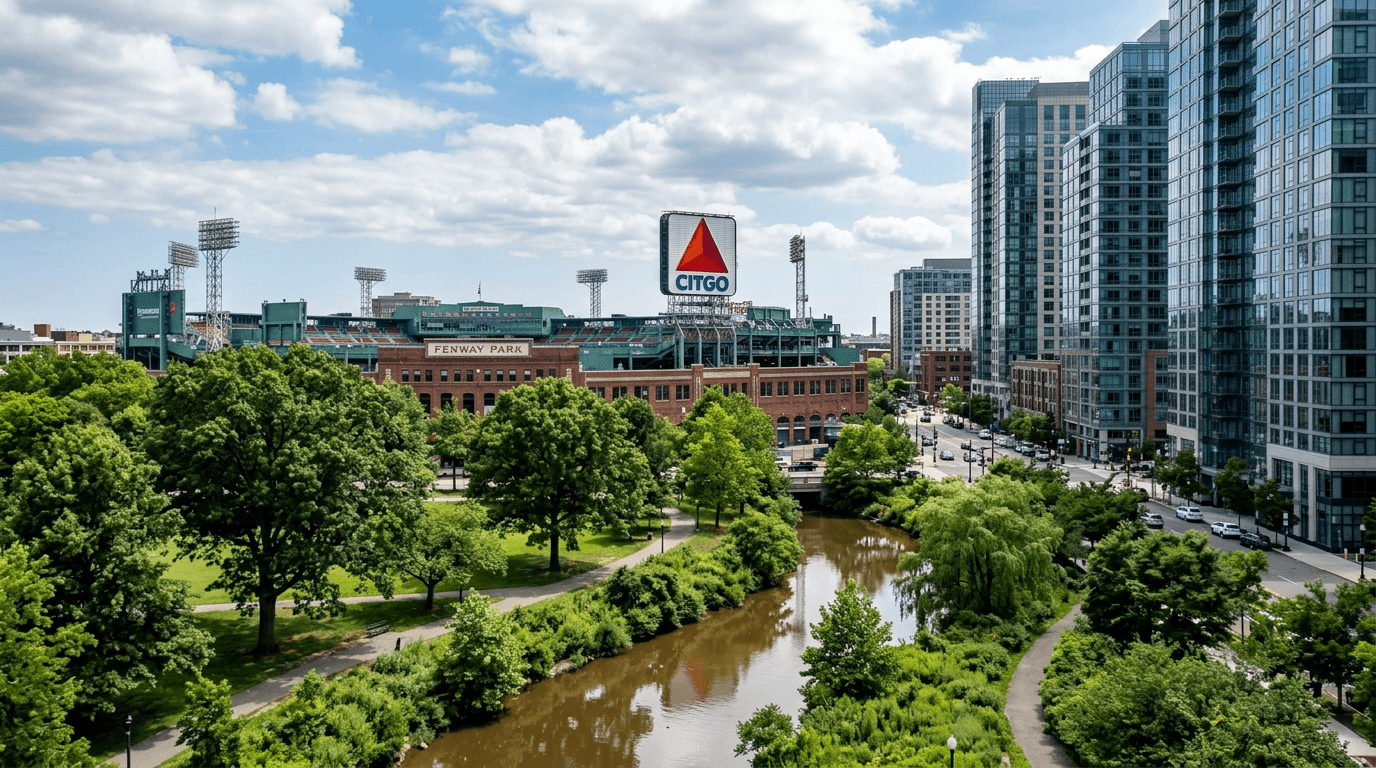
Kenmore Square is the northern gateway: the Citgo sign, Boston University's front door, the transit anchor. It's the most transactional of the four — coffee, groceries, the T. Row 34 and The Kenmore have given the square a real dinner scene that didn't exist a decade ago, which matters if you'd rather not commute to Back Bay for a good meal.
Lansdowne Street and Jersey Street are the entertainment engine. Fenway Park sits at the center, but the surrounding blocks — House of Blues, the bars, the pre-game spillover — run independently of the baseball schedule with concerts and events year-round. This is the highest-energy real estate in the neighborhood and the most divisive. Some buyers pay a premium for it. Others won't tolerate a single game night.
The Boylston Street corridor, sometimes called "New Fenway," is where most of the last decade's construction landed. Time Out Market Boston is the practical center of gravity: 29,000 square feet and 15+ vendors, functioning simultaneously as a remote-work spot, a first-date destination, and the default answer when a group of six can't agree on dinner. Trader Joe's , Whole Foods, Target, and Star Market all sit within this zone — an underrated quality-of-life factor for a car-free household.
The Museum corridor along Huntington Avenue and the southern Fens is the quiet, cultural end. The Museum of Fine Arts and the Isabella Stewart Gardner Museum are both here, with Symphony Hall a few blocks east and the Massachusetts Historical Society on Boylston. Residents on Peterborough and Queensberry Streets arguably get the best of both worlds: a five-minute walk to the ballpark, a five-minute walk to the Fens, and a residential street that empties out at night.
My rule of thumb for buyers is simple. Want energy at your doorstep? Look at Boylston and Lansdowne. Want energy three minutes away and calm at your doorstep? Look at Peterborough Street, Queensberry Street, Bay State Road, or the Symphony/Westland area.
How is the commute from Fenway-Kenmore to downtown Boston, Cambridge, and Longwood?
Direct answer: transit access is the single strongest argument for living here. The neighborhood scores 90/100 for transit and 80/100 for walkability, and a large share of residents commute on foot.
Urban Mobility Scores
Fenway-Kenmore’s strongest lifestyle advantage is access: high transit and walkability scores support a car-light routine, while bikeability and sound scores reflect the tradeoffs of a busy urban setting.
Walkability80/100
Transit Score90/100
Bikeability60/100
Sound Score63/100
Fenway-Kenmore’s strongest lifestyle advantage is access: high transit and walkability scores support a car-light routine, while bikeability and sound scores reflect the tradeoffs of a busy urban setting.
That radar chart is the honest picture: exceptional transit, excellent walkability, moderate bikeability, and a sound score reflecting the tradeoff of urban density. Only a small minority of residents commute by car, and vehicle ownership has fallen sharply since 2000. This neighborhood was designed to be lived without a car, and the people who fight that design are the ones who end up unhappy.
Green Line access. Kenmore Square is a major hub where the B, C, and D branches converge, meaning three separate lines deliver you to Copley, Arlington, Boylston, Park Street, and Government Center. Fenway station (D branch) serves the southern residential blocks, and Boston University East sits at the western edge. Downtown is a 10–15 minute ride. The E branch runs down Huntington Avenue for Museum-corridor residents and Longwood access.
A note on the E branch through 2029. Symphony station is undergoing a major accessibility rebuild, and if you're touring near Huntington Avenue, the timeline matters.
A major Green Line E Branch accessibility project near Fenway-Kenmore, adding elevators and raised platforms over a multi-year construction period—important for commuters tracking transit disruption and long-term access upgrades.
Station Age85-year-old
Construction Start DateJune 6
Estimated Duration3 years
Completion DateSummer 2029
Distance to Prudential Stop0.3 miles
Distance to Northeastern University Stop0.3 miles
Distance to Mass. Ave. Orange Line Station0.1 miles
A $66.6 million federally funded overhaul of an 85-year-old station, running roughly three years to a Summer 2029 completion. The good news is redundancy: Prudential and Northeastern University stops are each 0.3 miles away, and the Massachusetts Avenue Orange Line station is just 0.1 miles off. Buy in that pocket and you should expect construction noise near-term and a fully accessible station long-term — the kind of tradeoff that tends to be neutral-to-positive on resale.
Commuter Rail. Lansdowne station sits directly beside Fenway Park on the Framingham/Worcester Line, running to Back Bay and South Station in one direction and out through Newton, Wellesley, Natick, and Framingham in the other. For a young professional whose office moved to a suburban corporate campus, that's a genuine unlock. Live in the middle of the city, reverse-commute west, own no car.
Longwood Medical Area. This is the neighborhood's killer app. For anyone at Brigham and Women's, Beth Israel Deaconess, Dana-Farber, Boston Children's, or Harvard Medical School, Fenway-Kenmore is a 15–20 minute walk or a short D-branch/bus hop. I've placed a lot of residents and researchers here for exactly this reason. No commute beats walking.
Cambridge is the weak spot. Be clear-eyed about it: Fenway-Kenmore to Kendall Square or Harvard often runs 45+ minutes by transit, because it requires a Green Line ride plus a Red Line transfer, or a bus. Bikeability scores 60/100 — the Commonwealth Avenue Better Bike Lanes went in during 2025, which helps considerably, and Bluebikes stations are dense throughout the neighborhood. Still, if your job is in Cambridge, compare this neighborhood honestly against Cambridge-side options before you commit.
One safety note about the streets, not the crime stats. The Park Drive / Boylston / Brookline Avenue intersection is a documented top crash location in the city, currently a four-lane cross-section. A redesign has been in planning since 2011, Boston lost the federal funding for it in early 2026, and new funding is now proposed for 2031. If you bike or walk that junction daily, know it and route around it.
Is Fenway-Kenmore right for you?
Fenway-Kenmore rewards a specific buyer: someone who values access over square footage, who wants a career-stage neighborhood rather than a settling-down one, and who would genuinely rather walk to a museum, a ballgame, and a lab than own a driveway.
The tradeoffs are just as specific. You'll pay a premium per square foot for a compact unit. HOA fees demand real scrutiny. Parking costs money. Some blocks are loud. And a large share of properties here carry elevated long-term flood risk under First Street Foundation modeling — worth reviewing insurance and building-level flood mitigation as part of any offer, particularly in the low-lying blocks near the Fens.
The fundamentals underneath this market, though, are unusually durable: four universities, the largest medical complex in New England, a persistently tight rental market, an overwhelmingly white-collar workforce, and a growing population. Neighborhoods with that kind of built-in demand don't go quiet.
When we evaluate a specific unit here, the work gets granular — the actual reserve study, the actual game-night sound exposure, the actual walk time to your building's nearest T entrance, and the actual price-per-foot against the last six comparable sales in that same association. That street-level read is where the leverage sits in a market where Redfin shows 30.9% of listings taking price drops. Bring your shortlist and let's pressure-test it.
Is Fenway-Kenmore in Boston, MA a good place for young professionals?
Fenway-Kenmore is one of Boston’s strongest fits for young professionals who want a dense, car-optional lifestyle near work, transit, restaurants, museums, and nightlife. About 59% of residents are ages 18–24, with another 20% ages 25–34, and roughly 75% of adults hold a bachelor’s degree.
Is Fenway-Kenmore in Boston, MA good for families?
Fenway-Kenmore is better suited to residents who prioritize access, energy, and convenience over quiet residential space. The neighborhood is loud and dense in many areas, with significant student, medical, and early-career professional populations, so families looking for a calm, traditional residential feel may prefer quieter blocks such as Peterborough Street, Queensberry Street, Bay State Road, or areas near the Fens.
What are condos like in Fenway-Kenmore, Boston, MA?
Fenway-Kenmore is primarily a condo-and-apartment market with very few single-family homes and little private outdoor space. Housing includes early-1900s brick and brownstone buildings converted into condos or co-ops, mid-century elevator buildings, and newer luxury towers with amenities such as concierge service, roof decks, fitness centers, and package rooms.
How much do condos cost in Fenway-Kenmore, Boston, MA?
Fenway-Kenmore is a million-dollar-plus condo market, with a reported median sale price of $1,149,608 across 324 sales and year-over-year price growth of 8.7%. Standard one-bedrooms generally sell below the neighborhood median, while luxury one-bedrooms and larger two- or three-bedroom units can be substantially more expensive.
How expensive are HOA fees in Fenway-Kenmore condos?
HOA fees in Fenway-Kenmore vary widely by building, unit size, amenities, included utilities, and reserve health. In Kenmore Tower, fees range from about $370 per month to $4,700 per month, showing how different costs can be within a single building.
Is Fenway-Kenmore in Boston, MA affordable for renters?
Fenway-Kenmore has high rental costs, with median rents around $2,300 for a studio, $2,800 for a one-bedroom, $3,750 for a two-bedroom, and $5,300 for a three-bedroom. The jump from one-bedroom to two-bedroom rents is steep, which can make buying worth evaluating for residents planning to stay at least three years.
How is the commute from Fenway-Kenmore, Boston, MA to downtown, Longwood, and Cambridge?
Fenway-Kenmore has excellent transit access, with a transit score of 90/100 and walkability of 80/100. Downtown Boston is typically a 10–15 minute Green Line ride, and the Longwood Medical Area is about a 15–20 minute walk or a short transit trip.
What schools and universities are near Fenway-Kenmore, Boston, MA?
Fenway-Kenmore sits within Boston’s major university corridor, with Boston University, Northeastern, Berklee, Simmons, and Emmanuel nearby. The neighborhood also connects closely to the Longwood Medical Area, including Harvard Medical School and major hospitals such as Brigham and Women’s, Beth Israel Deaconess, Dana-Farber, and Boston Children’s.