Living in Wellesley, MA: The Essential Family Guide to Schools, Homes, and Commuting
Explore Wellesley’s family-first vibe: top schools, 44% lower crime, 3 commuter rail stops, $2.37M median homes, and walkable Square.
Written ByAndrew Schwartz
PublishedSeptember 9, 2026
We're SmartHub Boston, a data-driven brokerage led by Andrew Schwartz serving buyers, sellers, investors and landlords across Boston, Cambridge, Newton and Brookline. Serving Boston, Newton, Brookline, Cambridge, Somerville, Watertown, Natick, Wellesley and Weston, MA.
Wellesley, MA
Region
# Wellesley, MA Neighborhood Guide: The Ultimate Family-Friendly Suburb
Ask any young family looking west of Boston where they're considering, and Wellesley comes up almost every time. The reasons rarely vary: the schools, the safety, and the fact that Back Bay is about thirty minutes away by train. All true. But there's more to living here than a bullet list, so this guide gets into what the town actually feels like day to day — what's on the market, where families end up spending their weekends, and how the commute really shakes out once you're doing it five days a week.
Is Wellesley, MA a Good Town for Young Families?
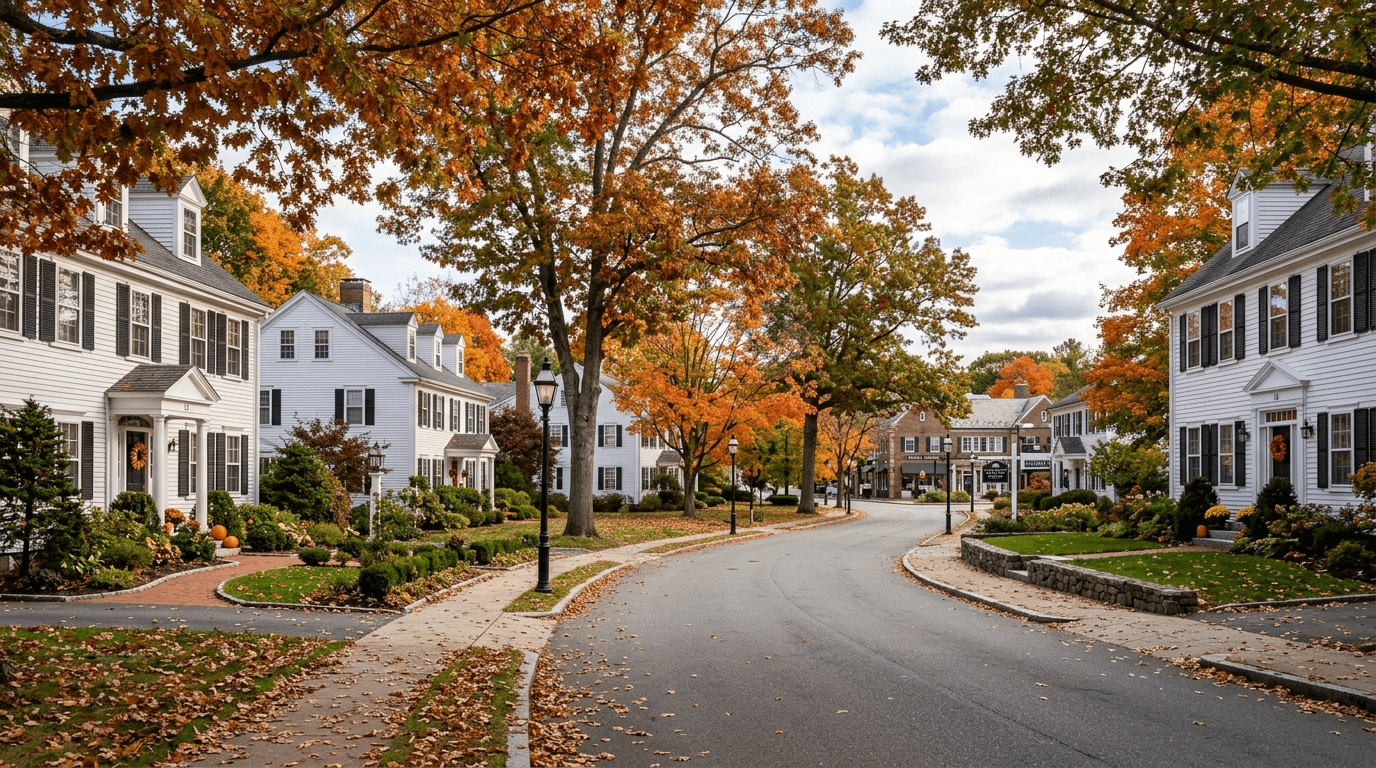
Yes — Wellesley is one of the most family-oriented suburbs in Greater Boston, combining a top-ranked public school district, a crime rate roughly 44% below the national average, and a genuinely walkable town center. It's quiet in the best possible way. Tree-lined streets, kids on bikes after dinner, neighbors who know your kids by name.
The rhythm here is unmistakably residential. Density is low enough to mean real yards, real sidewalks, and streets where a soccer ball rolling off a lawn isn't a heart-stopping moment. Weekday mornings hum with school drop-off and commuter rail traffic. By mid-morning, the whole town exhales into a calm that holds until the buses come back.
Safety comes up in nearly every conversation with families relocating here. Wellesley carries an overall B+ crime grade, and the town ranks in roughly the 82nd percentile for safety nationally. Several neighborhoods score even higher.
Neighborhood Safety Snapshot
A quick family-oriented reference for Wellesley neighborhood safety grades, highlighting several areas rated A or better.
Babson Park, Overbrook, and the Fells all earn A+ marks. Dana Hall and Wellesley Square sit at A. What I tell families touring here is that these differences are marginal in any practical sense — the whole town reads as safe. The distinction that actually matters between neighborhoods usually comes down to something else entirely: whether you can walk to a particular elementary school, or to a particular train stop.
What makes the community click:
•The schools. Massachusetts ranks #1 nationally for K-12 education, and Wellesley sits near the top of the state. The district runs six elementary schools, one middle school, and one high school — small enough that families feel known, big enough for real programming depth.
•Civic investment. The FY2026 school budget landed at $94,035,026, roughly 44% of the total town budget. That's a community voting with its wallet.
•Traditions that stick. Wellesley Wonderful Weekend, the Memorial Day parade, the Turkey Trot. These are the annual anchors that turn a house purchase into an actual neighborhood.
One practical note for families with little ones. Wellesley kindergarten eligibility requires a child to turn 5 by August 31, and for the 2026–27 year the parent portal window runs August 19 through September 9, 2026, with kindergarten full days beginning September 14. If you're targeting a specific school year, plan your move backward from those dates.
What Kinds of Homes Are For Sale in Wellesley, MA?
Wellesley is overwhelmingly a single-family market — about 81% of recent closings — dominated by classic New England Colonials, Tudors, Capes, and mid-century ranches on lots typically running from a quarter-acre to over a half-acre. As of July 2026, the median single-family sale price was $2,367,500, with a median of 25 days on market and 2.8 months of supply.
That's the honest starting point. Wellesley is an expensive town, and no version of this guide is going to pretend otherwise.
Wellesley Housing Market Snapshot: Family Buyer Baseline
Headline market metrics families should understand before touring: Wellesley remains a high-price, mostly single-family market with limited supply and fast contract timelines.
Here's how I frame it for families: the market is deep, but it isn't uniform. Across the last six months of tracked closings, the middle half of sales landed between roughly $1,365,000 and $3,050,000. That's a wide band, and there's meaning in the spread. A real entry tier exists here — usually a smaller Cape or a 1950s–70s colonial in need of cosmetic work, often tucked onto a quieter side street. There's also a genuine high end, concentrated in the Cliff Estates area, where the character shifts toward estate lots and custom builds.
What Architectural Styles Will You Find in Wellesley, MA?
•Colonials — the workhorse of Wellesley. Center entrance, four bedrooms up, formal rooms down. Many date to the 1950s, 60s, and 70s, so the bones are solid, but kitchens and baths have usually been redone once or twice.
•Tudors and Shingle-style homes — clustered in the older Wellesley Hills and Wellesley Farms pockets near the commuter rail. Full of character, occasionally full of the quirks that come with age.
•Capes and Ranches — the most attainable single-family entry point, often sitting on generous flat lots with real backyard potential.
•New construction and gut renovations — Wellesley has an active builder market, so brand-new homes on older lots turn up regularly, with open-plan layouts, mudrooms, and finished lower levels.
Lot size is where Wellesley genuinely delivers for young families. A quarter-acre to half-acre-plus gives you room for a swing set, a trampoline, and a garden — the kind of space you simply can't buy at comparable price points in Brookline or the denser stretches of Newton.
Are there condos and townhomes in Wellesley, MA?
They exist, but the segment is small. As of July 2026, the condo/townhouse market showed a median sale price of $1,270,000, a median of 78 days on market, and only 14 active listings. That's a thin, slower-moving pool. Condos here tend to draw downsizers and empty-nesters rather than young families, and units genuinely suited to a family of four are rare enough that patience is part of the plan.
Multi-family is essentially nonexistent in town — zero active listings and a single closed sale as of that same July 2026 snapshot.
How Have Price-Per-Square-Foot Trends Moved in Wellesley, MA?
Monthly Median Price Per Square Foot
A month-by-month look at Wellesley’s median sold price per square foot, showing a summer lift in July before easing slightly in August.
A month-by-month look at Wellesley’s median sold price per square foot, showing a summer lift in July before easing slightly in August.
Median sold price per square foot started around $667 in April 2026, dipped to about $645 in May and $648 in June, climbed to $697 in July, then eased to $677 in August. Read that plainly: spring softened, summer brought a modest lift, and the market has been steady rather than volatile. The takeaway for your budget is that pricing discipline is real here. Well-priced homes move quickly. Overpriced ones sit.
What should families budget for property taxes in Wellesley, MA?
Wellesley's FY2026 residential tax rate is $10.17 per $1,000 of assessed value — one of the lower rates in Greater Boston, though the high assessments mean the bills still add up. There's also a 1% Community Preservation Act surcharge.
Some rough monthly math to help you plan:
Data Table
Purchase Price
Annual Tax + CPA
Est. Monthly
$1,000,000
$10,272
$856
$1,500,000
$15,408
$1,284
$2,000,000
$20,543
$1,712
Add a stormwater utility fee for single-family homes, which runs roughly $157.50 to $382.50 annually (about $13–$32/month), and you've got a fairly complete picture of what carrying the house costs beyond principal and interest.
Where Do Families Gather in Wellesley, MA?
The three anchors of family life in Wellesley are Wellesley Square, Morses Pond, and the Wellesley Free Library — with Linden Square handling everyday shopping and errands. These are the places you'll end up two or three times a week without ever planning to.
What Is Wellesley Square Like for Families in Wellesley, MA?
The Square is the town's living room. A walkable stretch of Central Street lined with local boutiques, bookshops, cafes, and restaurants that welcome kids without being kid-only. On a Saturday morning, stroller traffic, high schoolers, and retirees all share the same sidewalk. Quebrada Baking Company is a longtime institution here — and one of those places where you'll inevitably run into someone from your child's class.
For a low-stakes weeknight dinner out, Mortadella Head Wellesley has become a reliable go-to. Loud enough that a toddler meltdown goes completely unnoticed.
What Can Families Do at Morses Pond in Wellesley, MA?
If one amenity sells young families on Wellesley, it's Morses Pond. Town-owned, with a supervised swimming beach, boat rentals, a playground, and a bathhouse, it becomes the default summer destination from June through August. Kids age out of the swim lessons and into the lifeguard chairs. That kind of generational continuity is exactly what people mean when they call Wellesley a "raise-them-here" town.
What Does the Free Library Offer Families in Wellesley, MA?
The main library and its Hills branch run genuinely robust children's programming — storytimes, STEM workshops, summer reading challenges. For parents of toddlers getting through a New England winter, the library isn't an amenity. It's a survival tool.
Where Do Families Handle Everyday Errands in Wellesley, MA?
Linden Square covers the practical side of family life: grocery runs, pharmacy, coffee, and casual dining that works on a Tuesday. It's the town's second walkable hub, and homes within a short walk of it hold their appeal for exactly that reason.
What's Happening With School Facilities in Wellesley, MA?
Families touring here often ask about the buildings themselves, not just the test scores. Two projects are worth knowing about:
School Infrastructure Projects
Current school facility improvements that matter to families, including comfort upgrades and athletic facility timing.
Air conditioning is going in across four schools — a meaningful quality-of-life upgrade for those sticky June and September stretches — and the Hunnewell Track & Field team rooms are expected to come online in Fall 2026, following the Special Town Meeting held on 11/3/25.
How Full Are the Schools in Wellesley, MA?
Wellesley Public Schools Enrollment Projections
Projected 2026–27 enrollment by school level, useful for young families weighing elementary, middle, and high school capacity across the district.
Projected 2026–27 enrollment by school level, useful for young families weighing elementary, middle, and high school capacity across the district.
Projected FY'27 enrollment sits at roughly 1,726 students in K–5, 855 in grades 6–8, and 1,189 in grades 9–12. For young families, K–5 is the number to watch. It's the largest cohort, but it's spread across six elementary schools, which keeps individual building sizes manageable. When you're comparing houses, confirm the elementary assignment early — it shapes your daily routine for the better part of a decade.
How Is the Commute from Wellesley, MA to Boston?
Wellesley offers one of the best commuter setups in the western suburbs: three MBTA Commuter Rail stations on the Framingham/Worcester Line, with typical rides of 30 to 40 minutes into Back Bay and South Station. Add direct access to Route 9, I-95 (Route 128), and the Mass Pike (I-90), and most working parents find they have real options depending on the day.
How Does the Commuter Rail Work in Wellesley, MA?
Three stops, all on the Framingham/Worcester Line, each serving a different corner of town:
•Wellesley Farms — the northernmost stop, closest to the Farms and Cliff Estates neighborhoods. Slightly shorter ride into Boston.
•Wellesley Hills — serves the Hills, with a small commercial pocket around it.
•Wellesley Square — the most walkable of the three, dropping you steps from the Square's shops and cafes. This is the stop that makes a car-light morning genuinely possible.
Both Back Bay and South Station are on the line, which matters if your office is in the Seaport, the Financial District, or the Longwood Medical Area — an easy transfer from Back Bay.
What Is Driving to Boston Like from Wellesley, MA?
Wellesley sits roughly 15 to 20 miles from downtown. Realistic drive times:
The honest caveat: Massachusetts drivers average about 60 hours a year stuck in traffic, and I-95 and the Pike do their part. The families happiest here are the ones who take the train on the ugly days and drive when the schedule demands flexibility.
For dual-career households, the setup is particularly forgiving. One parent catches the 7:12 out of Wellesley Square while the other drives to a suburban office park in 20 minutes. That combination is hard to replicate closer to the city, where you gain transit access but give up the yard and the school district.
What Should Families Know Before Buying in Wellesley, MA?
A few things worth internalizing before you start touring:
•Move quickly on the right house, but don't chase the wrong one. With single-family supply at 2.8 months and a median of 25 days on market as of July 2026, good homes go under agreement fast. Sellers who overprice still sit, though — and that gap is where prepared buyers find leverage.
•Confirm the elementary district in writing. Boundaries matter, and assumptions built on "it's close to X school" have burned buyers before.
•Budget for the full carrying cost. Between property tax, the CPA surcharge, stormwater fees, and typical annual water/sewer increases of roughly $25 to $80, the monthly picture runs meaningfully higher than principal and interest alone.
•Think in five-to-ten-year terms. Families who buy here tend to stay through the school years. Prioritize the lot, the layout, and the walk to school over finishes you can change later.
Wellesley isn't a value play, and it's never claimed to be. What it offers instead is a rare combination — a school district that consistently delivers, streets safe enough to let a nine-year-old bike to a friend's house, a walkable center you'll actually use, and a train that gets you to your desk in about half an hour. For young families sorting through the western suburbs, that combination is the whole argument.
Local Spots & Favorites
Wellesley Market Statistics
Median sale price, days on market, and closed sales by property type.
Yes. Wellesley, MA is one of Greater Boston’s most family-oriented suburbs, with a top-ranked public school district, a crime rate roughly 44% below the national average, and a walkable town center. Families are drawn to its tree-lined streets, sidewalks, larger yards, and community traditions like Wellesley Wonderful Weekend, the Memorial Day parade, and the Turkey Trot.
How are the public schools in Wellesley, MA?
Wellesley, MA is known for strong public schools in a state that ranks #1 nationally for K-12 education. The district includes six elementary schools, one middle school, and one high school, with projected FY’27 enrollment of about 1,726 students in K–5, 855 in grades 6–8, and 1,189 in grades 9–12. Families should confirm elementary school assignments early when comparing homes.
Are there condos and townhomes for sale in Wellesley, MA?
Yes, but condos and townhomes are a small part of the Wellesley, MA housing market. As of July 2026, the condo and townhouse median sale price was $1,270,000, with a median 78 days on market and only 14 active listings. Family-sized units are relatively rare, and this segment tends to attract downsizers and empty-nesters more than young families.
How much does it cost to buy a home in Wellesley, MA?
Wellesley, MA is an expensive single-family market. As of July 2026, the median single-family sale price was $2,367,500, with a median 25 days on market and 2.8 months of supply. Recent middle-market sales ranged roughly from $1,365,000 to $3,050,000, with smaller Capes or older Colonials typically forming the more attainable entry tier.
What are property taxes like in Wellesley, MA?
Wellesley’s FY2026 residential tax rate is $10.17 per $1,000 of assessed value, plus a 1% Community Preservation Act surcharge. Estimated annual tax plus CPA is about $10,272 on a $1,000,000 home, $15,408 on a $1,500,000 home, and $20,543 on a $2,000,000 home. Single-family owners should also budget for a stormwater utility fee of roughly $157.50 to $382.50 per year.
What is the commute from Wellesley, MA to Boston like?
Wellesley, MA has three MBTA Commuter Rail stations on the Framingham/Worcester Line: Wellesley Farms, Wellesley Hills, and Wellesley Square. Typical train rides to Back Bay and South Station take about 30 to 40 minutes. Drivers also have access to Route 9, I-95/Route 128, and the Mass Pike, with peak trips to downtown Boston often taking 30 to 45+ minutes.
What kinds of homes are common in Wellesley, MA?
Wellesley, MA is primarily a single-family housing market, with single-family homes making up about 81% of recent closings. Common styles include classic New England Colonials, Tudors, Capes, ranches, Shingle-style homes, and newer construction on older lots. Lots often range from a quarter-acre to more than a half-acre, which is a major draw for families wanting yard space.
What amenities do families use most in Wellesley, MA?
Family life in Wellesley, MA often centers around Wellesley Square, Morses Pond, the Wellesley Free Library, and Linden Square. Wellesley Square offers walkable shops, cafes, and restaurants, while Morses Pond provides a town-owned swimming beach, boat rentals, a playground, and a bathhouse. The library offers children’s programming, and Linden Square is a practical hub for errands, groceries, pharmacy trips, coffee, and casual dining.