Living in the Seaport District: The Essential Guide for Young Professionals
Explore Seaport’s high-energy waterfront vibe: 20 blocks, luxury condos, Fort Point lofts, Silver Line access, Logan in about 20 minutes.
Written ByAndrew Schwartz
PublishedSeptember 9, 2026
We're SmartHub Boston, a data-driven brokerage led by Andrew Schwartz serving buyers, sellers, investors and landlords across Boston, Cambridge, Newton and Brookline. Serving Boston, Newton, Brookline, Cambridge, Somerville, Watertown, Natick, Wellesley and Weston, MA.
# Living in the Seaport District: The Ultimate Guide for Young Professionals
In a city that's been building on itself for four centuries, the Seaport District is the rare exception — a genuine blank slate. Twenty-three acres. Twenty blocks. What was once parking lots and working piers is now 7.6 million square feet of glass towers, waterfront promenades, and ground-floor retail. Ask any young professional where they're considering in Boston, and the Seaport almost always makes the list.
This guide covers the questions we actually field on tours: what it feels like to live here, what your money buys, where people gather, and how you'll get to work.
What is the vibe like in the Seaport District — is it quiet or busy?
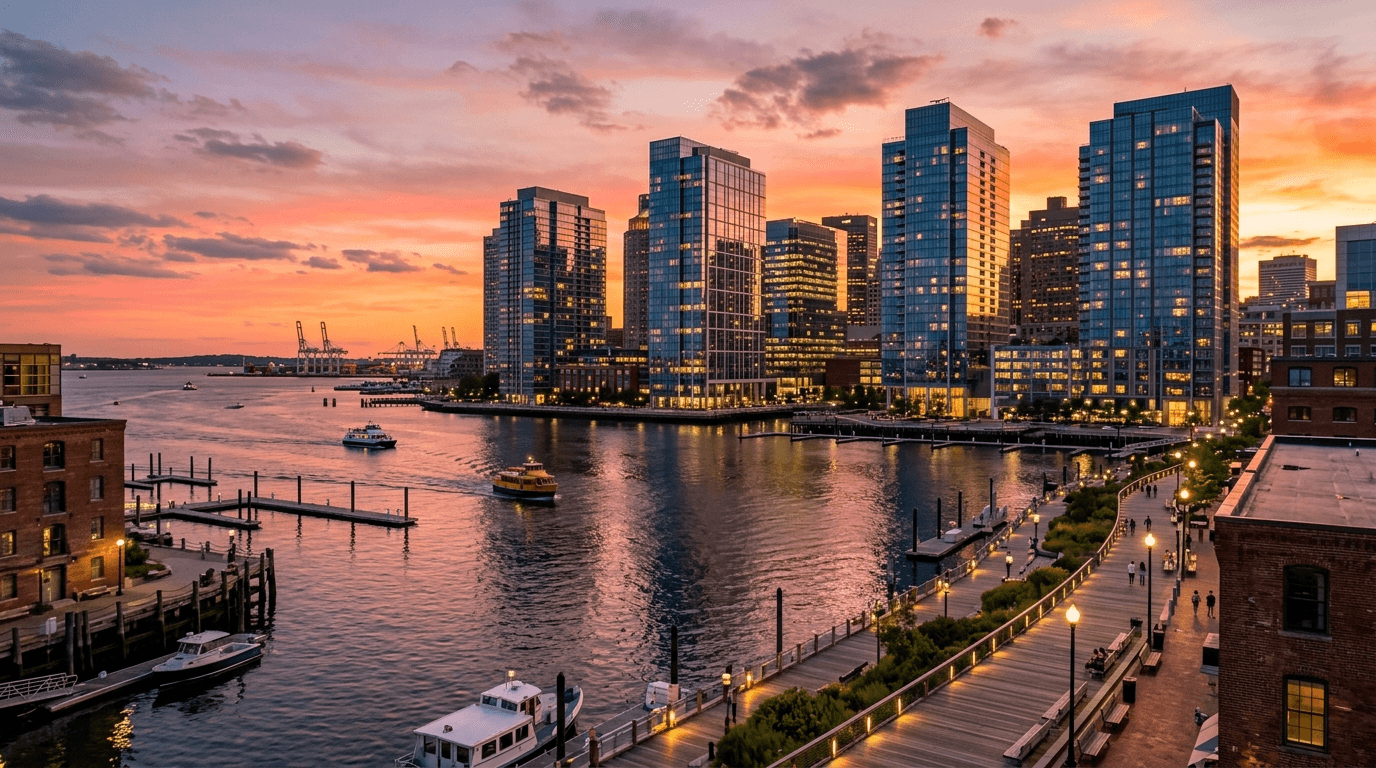
The Seaport is Boston's busiest, most high-energy neighborhood, and it never fully powers down. There are no quiet, tree-lined side streets here. This is a live-work-play district where hundreds of companies share sidewalks with rooftop bars, boutique fitness studios, and a packed calendar of free public programming.
What that looks like day to day:
•Weekday mornings are corporate and fast. Amazon's One Boston Wharf Road tower, Vertex Pharmaceuticals, PwC, and a dense cluster of tech, finance, and biotech firms release thousands of workers onto Seaport Boulevard between 8 and 9 a.m. The coffee lines are real. Drip Cafe by Craft Food Halls moves quickly if you're pressed.
•Weekday evenings flip social. Happy hour spills onto patios, and the Harborwalk fills with runners and dog walkers.
•Weekends — especially in summer and early fall — bring the rest of the city in. Tourists, cruise passengers, convention crowds, and suburbanites all converge at once. If a silent Saturday afternoon matters to you, that's the honest trade-off.
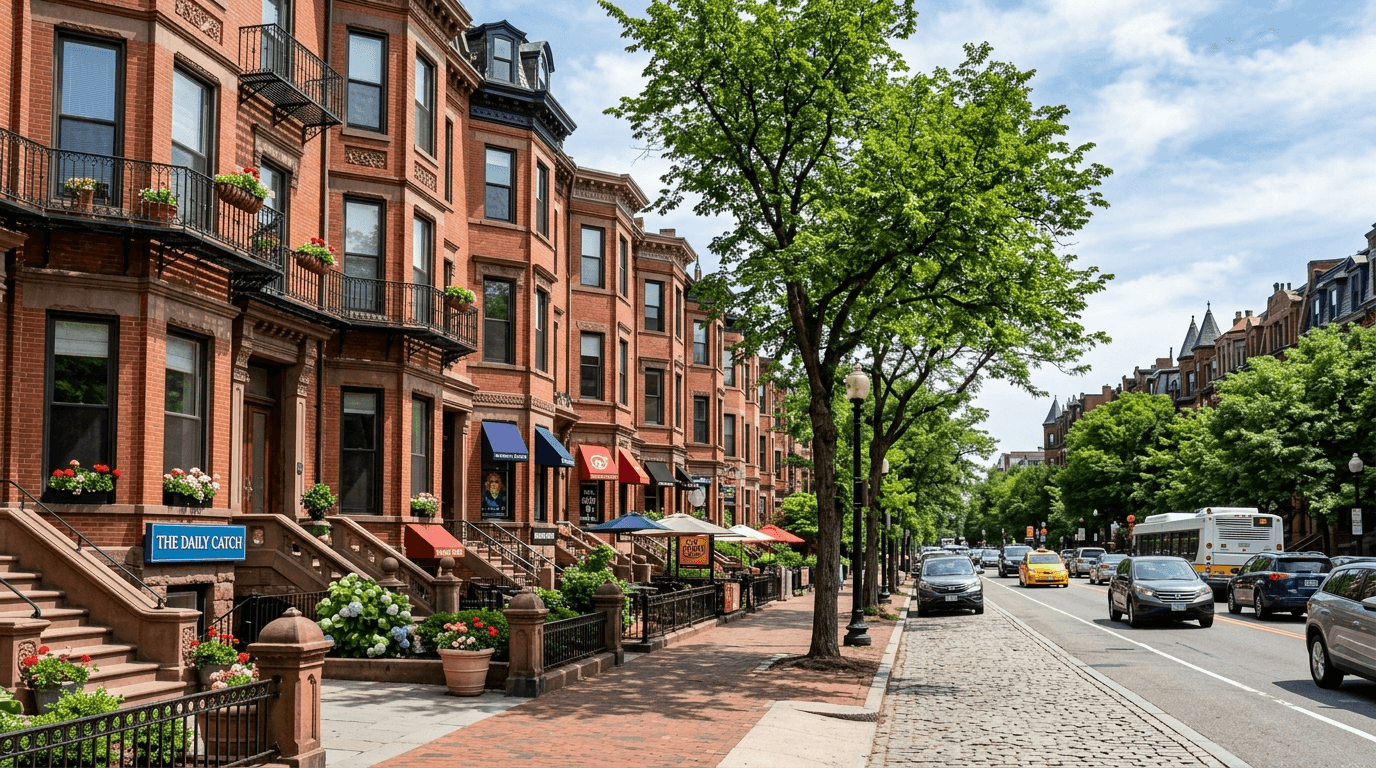
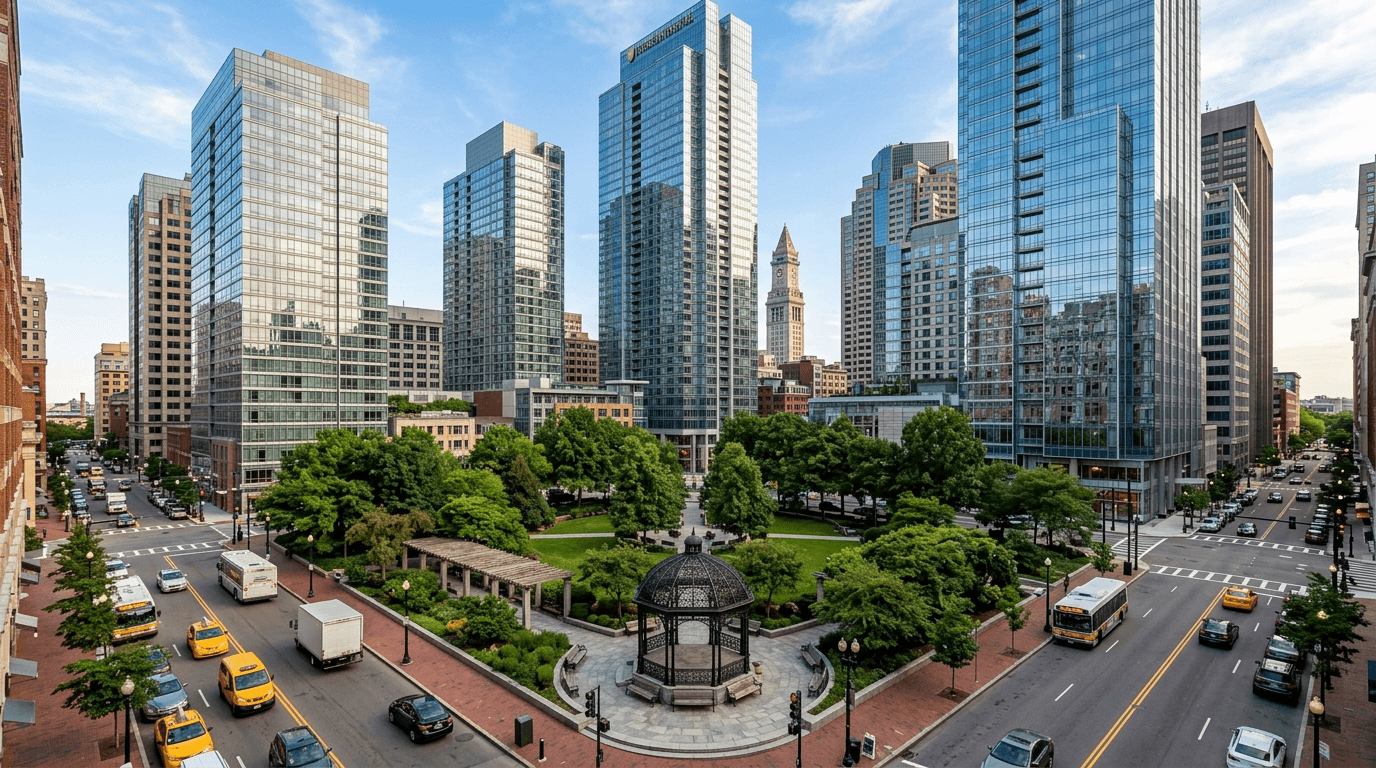
Aesthetically, this is really two neighborhoods stacked on each other. Along Fan Pier and Pier 4, everything is sleek and new: floor-to-ceiling glass, harbor light, wide plazas. Walk a few blocks inland to Fort Point and the tone shifts entirely — 19th-century brick-and-beam warehouses, loading docks converted into storefronts, and the largest artist community in New England still holding ground in the wool district lofts.
The appeal for young professionals is straightforward. Your gym, your office, your grocery run, and your Friday night all sit within a ten-minute walk. That's rare, even in a walkable city.
$22 billionPublic Investment
Boston Seaport District Regeneration: Scale & Investment
A project-level summary of the Seaport’s large-scale redevelopment, useful for understanding why the neighborhood feels like one of Boston’s most modern, corporate, amenity-rich urban districts.
One thing worth knowing: the population here skews highly educated and career-focused. South Boston Waterfront residents hold college and graduate degrees at a far higher rate than the city overall. Step into a building lobby and you're far more likely to meet consultants, biotech researchers, and finance associates than multi-generational Boston families.
What are condos and townhomes like in the Seaport District?
The Seaport is overwhelmingly a condominium market — high-rise, full-service, and the most expensive price-per-square-foot neighborhood in Boston. There's no meaningful single-family inventory, and "typical lot size" doesn't really apply in a district built vertically on filled land.
What are the main housing types in the Seaport District?
1. Luxury high-rise condominiums (the dominant product).
Buildings like 50 Liberty, 133 Seaport Boulevard (Echelon), Pier 4, and the St. Regis Residences set the tone. Expect:
•Floor-to-ceiling glass with harbor, skyline, or Fort Point Channel views
•Open-plan layouts — typically 700–1,100 sq ft for one-bedrooms, 1,200–2,200+ sq ft for two- and three-bedrooms
•24/7 concierge, valet or garage parking, fitness centers, resident lounges, co-working space, pet spas, and often a pool or roof deck
•HOA fees to match. Full-service amenity packages in new construction are expensive, and this is the single line item buyers most consistently underestimate.
2. Fort Point loft conversions (the value play).
The converted brick-and-beam warehouses along Summer, Congress, and A Street deliver timber columns, arched windows, exposed brick, and 11–14 foot ceilings. Amenities are lighter and buildings are smaller, but pricing per foot is materially lower. When a client says they want Seaport energy without Seaport pricing, Fort Point is the first stop.
3. A small number of ultra-modern townhomes and duplexes.
Rare. Usually at the base of towers or tucked into boutique infill buildings, sometimes with private rooftop decks or direct street entry. They trade infrequently and command a premium for the privacy.
What do Seaport District condos actually cost?
The Seaport carries the highest price per square foot of any Boston neighborhood, and the high-end new construction along the water shows why — the Seaport core has posted a median sale price near $2.98 million at roughly $1,940 per square foot, with a median of about 93 days on market.
Seaport Core Market Snapshot: March 2026
Headline condo-market numbers for Boston’s Seaport core, highlighting the premium pricing and slower luxury-market velocity young professionals should understand before buying downtown.
Those figures need context, because they describe the top of the market, not the whole thing.
Seaport Micro-Market Price Per Square Foot Ranges
Seaport is not one uniform luxury market. This range view compares price-per-square-foot spreads across Fan Pier, Fort Point, Seaport Core/Pier 4, and the Convention Center District.
Seaport is not one uniform luxury market. This range view compares price-per-square-foot spreads across Fan Pier, Fort Point, Seaport Core/Pier 4, and the Convention Center District.
This is the chart I put in front of every buyer on a first call. The Seaport isn't one market. It's four:
•Fan Pier: roughly $1,700–$2,300+/sq ft
•Seaport Core / Pier 4: roughly $1,900–$2,255+/sq ft
•Convention Center District: roughly $1,000–$1,700/sq ft
•Fort Point: roughly $700–$1,400/sq ft
The gap between Fort Point's floor and Fan Pier's ceiling is enormous. A young professional buying a first home in the Seaport is almost always shopping the lower two tiers — and that's a legitimate entry point, not a consolation prize.
Is now a good time to buy in the Seaport District?
The longer arc has been strong. Average sale prices dipped in 2022, then rebounded sharply, climbing from roughly $1.88M in 2022 to about $2.62M by 2025.
Seaport Condo Sale Price Trend: 2021–2025
A required time-series view showing Seaport condo sale prices rebounding from 2022 and climbing to more than $2.6M by 2025.
A required time-series view showing Seaport condo sale prices rebounding from 2022 and climbing to more than $2.6M by 2025.
The ultra-luxury tier tells a different story. Urban-core sales above $3M were down about 35% year over year, and the St. Regis Residences alone has carried roughly 47 unsold units. Seaport condo inventory has been building, and units are sitting longer before they sell — the current median of about 93 days on market is a noticeably slower pace than buyers faced at the peak of the post-2022 run-up.
What that means practically: entry and mid-tier product stays competitive, but above $3M you have real leverage. Concessions, upgrade credits, developer flexibility — all of it is on the table in a way it wasn't three years ago. And with borrowing costs still well above where they sat a few years back, the monthly math matters more than ever. The HOA line is usually where a Seaport purchase either works or doesn't.
Where do people gather in the Seaport District?
Social life here organizes around a handful of outdoor public spaces and a compact retail spine — which is precisely why the neighborhood feels social rather than sterile. Open space and parks were written into the master plan from the start, so the gathering spots were designed in, not retrofitted.
What are the key landmarks in the Seaport District?
•The Lawn On D — The neighborhood's unofficial backyard, famous for its glowing illuminated swings, lawn games, food trucks, and a steady run of concerts and community events. Its Grove extension has become a dependable warm-weather spot for after-work drinks.
•Institute of Contemporary Art (ICA) — Boston's leading contemporary art museum, and a piece of waterfront architecture worth the trip for the cantilevered harbor views alone. Free Thursday evenings are a standing date-night move among residents.
•Seaport Common — Small but heavily used, sitting at the heart of the retail district and hosting fitness classes, markets, and pop-up programming.
•Harbor Way Promenade — A third-of-a-mile pedestrian artery with an adjoining 1.5-acre park, linking the inland blocks directly to the water. It's the spine of the district's walkability.
•The Superette and the retail corridor — The dining, boutique, and pop-up shopping stretch along Seaport Boulevard and Harbor Way, including rotating pop-up villages, Salt & Straw, Trader Joe's, and dozens of restaurants.
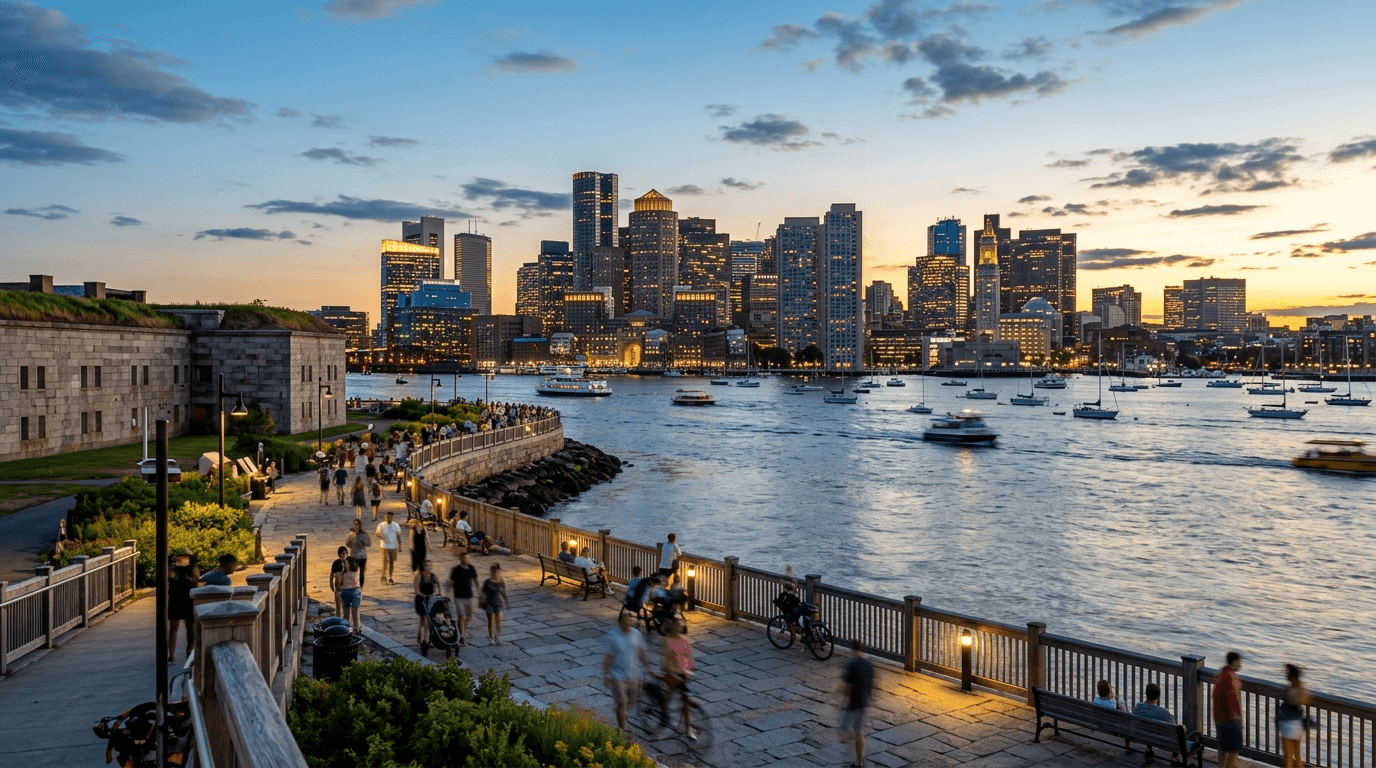
•The Harborwalk, Eastport Park, and Martin's Park — Waterfront green space that makes the district genuinely livable, plus the best running and cycling routes in the neighborhood.
Layer on the dining depth — Legal Harborside's flagship, Woods Hill Pier 4, Committee, Flight Club, the Lookout Rooftop — and most residents rarely need to leave for a night out.
On the practical side: there's a Trader Joe's , multiple pharmacies, and boutique studios like [solidcore] Seaport . Daily errands work without a car, which is rather the point.
How is the commute from the Seaport District to downtown Boston, Cambridge, and Logan Airport?
Excellent to downtown and the airport, good-to-moderate to Cambridge, and better than its reputation for drivers — provided you understand that the Silver Line is a bus, not a subway. The Seaport was built for commuters, and transit access is arguably its strongest practical selling point.
What are the transit options in the Seaport District?
MBTA Silver Line (SL1, SL2, SL3, SLW)
The district's transit backbone, running through a dedicated underground transitway with stops at Courthouse and World Trade Center before continuing to South Station.
•SL1 → direct to Logan Airport, stopping at every terminal. Living 20 minutes from your gate is a legitimate lifestyle upgrade if you travel for work. (Inbound from the airport is free.)
•SL2 → Design Center and the Marine Industrial Park side of the district
•SL3 → Chelsea via East Boston
•SLW → South Station shuttle service
South Station (a 10–15 minute walk from most Seaport buildings)
This is the piece that makes the Seaport work regionally:
•Red Line → Downtown Crossing, Park Street, and straight into Kendall Square and Harvard Square. For a biotech or tech professional splitting time between Seaport and Kendall, that's roughly a 20-minute ride.
•Commuter Rail → the entire southern and western suburban network
•Amtrak → Northeast Corridor service to Providence, New York, and Washington
•South Station Bus Terminal → intercity coach service
Frequency is trending the right way, too. Scheduled weekday trips have increased across the core rapid transit lines heading into the winter 2025–2026 schedule, with the Red Line rising from 406 to 448 scheduled weekday trips.
Scheduled Weekday Trip Growth by MBTA Line
Transit frequency is central to car-light urban living. This grouped comparison shows scheduled weekday trips increasing across Orange, Red, and Blue lines from winter 2024–2025 to winter 2025–2026.
Orange Line
Red Line
Blue Line
Transit frequency is central to car-light urban living. This grouped comparison shows scheduled weekday trips increasing across Orange, Red, and Blue lines from winter 2024–2025 to winter 2025–2026.
Water taxis and ferries
Boston Harbor water taxi service connects the Seaport's docks to Logan Airport, Charlestown, the North End, and East Boston. It isn't the cheapest commute. On a clear September morning, it's unquestionably the best one — and it's a genuine backup when the Silver Line tunnel backs up.
Driving and highway access
Direct ramps to I-90 (the Mass Pike) and quick access to I-93 make the Seaport one of the easiest downtown-adjacent neighborhoods to drive out of. Heading west to Newton, Wellesley, or Natick on a weekend is painless. The catch is the same one you'll find everywhere in Boston: parking. Deeded garage spaces trade at a serious premium, and monthly rentals are expensive. Most residents we work with go car-light or car-free, leaning on Zipcar or rideshare for the occasional trip.
Walking and biking
Walk Scores here rank near the top of the city. The Harborwalk and Fort Point Channel bridges make foot commutes to the Financial District and South End easy, and Bluebikes docks are dense throughout the district. Ongoing city roadway and bike infrastructure projects keep improving the connections inland.
Is the Seaport District right for you?
The Seaport makes sense if you want maximum energy, maximum amenity, and a walk-to-everything lifestyle — and you're prepared to pay Boston's highest price per square foot for it. The strongest fits are young professionals working downtown, in the Seaport itself, or in Kendall Square via the Red Line, particularly frequent travelers who value that 20-minute Logan run.
It's a weaker fit if you're after quiet, historic charm, a yard, or the best value per dollar. If those rank higher on your list, we'd point you toward South Boston proper, East Boston, or Charlestown — all close by, all meaningfully less expensive per foot.
If you do want to be here, the real question is which micro-market. Fort Point and the Convention Center District are where first-time buyers realistically compete. Fan Pier and Pier 4 are where you buy views and services. And above $3M, the current inventory picture gives you negotiating room that simply didn't exist a few years ago.
That street-level distinction — which building, which tier, which HOA structure — is where a Seaport purchase gets made or lost.
Is the Seaport District in Boston, MA a good place for young professionals?
Yes. The Seaport District is a high-energy live-work-play neighborhood where offices, gyms, grocery options, restaurants, bars, and waterfront paths are clustered within a short walk. It is especially practical for young professionals working in the Seaport, downtown Boston, or Kendall Square.
What types of condos and townhomes are available in Boston, MA’s Seaport District?
The Seaport District is primarily a condominium market, dominated by luxury high-rise buildings with concierge service, garage or valet parking, fitness centers, resident lounges, co-working space, and roof decks or pools in many buildings. Fort Point offers converted brick-and-beam lofts with exposed brick, timber columns, arched windows, and lighter amenity packages. Townhomes and duplexes exist but are rare and typically command a premium.
How much do condos cost in the Seaport District in Boston, MA?
The Seaport has the highest price per square foot of any Boston neighborhood. The Seaport core has shown a median sale price near $2.98 million at about $1,940 per square foot, with a median of roughly 93 days on market. Pricing varies widely by micro-market, from about $700–$1,400 per square foot in Fort Point to roughly $1,900–$2,255+ per square foot around the Seaport Core and Pier 4.
Are HOA fees expensive in Boston, MA’s Seaport District condos?
Yes. Full-service Seaport condo buildings often carry high HOA fees because amenities such as 24/7 concierge, valet or garage parking, fitness centers, lounges, co-working spaces, pet spas, pools, and roof decks are expensive to operate. The HOA line item is one of the most important affordability factors for Seaport buyers.
Is the Seaport District in Boston, MA affordable for first-time buyers?
The Seaport is expensive overall, but first-time buyers most often compete in Fort Point and the Convention Center District rather than the highest-priced waterfront towers. Fort Point typically offers lower price-per-square-foot options than Fan Pier, Pier 4, and the Seaport core, making it a more realistic entry point into the neighborhood.
How is the commute from the Seaport District in Boston, MA to downtown, Cambridge, and Logan Airport?
The Seaport has excellent access to downtown Boston and Logan Airport, with the MBTA Silver Line serving Courthouse and World Trade Center and the SL1 running directly to Logan terminals. South Station is a 10–15 minute walk from many Seaport buildings, providing Red Line access to downtown, Kendall Square, and Harvard Square. For Cambridge tech or biotech commuters, the Red Line connection from South Station makes Kendall Square roughly a 20-minute ride.
Is Boston, MA’s Seaport District a good fit for families with children?
The Seaport can work for families that prioritize walkability, waterfront parks, grocery access, pharmacies, and nearby public spaces such as Martin’s Park, Eastport Park, the Harborwalk, and The Lawn On D. It is less ideal for families seeking quiet streets, historic residential charm, a private yard, or the best value per dollar. Families should verify current school assignments and fit directly, since school-specific details are not a defining feature of the Seaport housing profile.