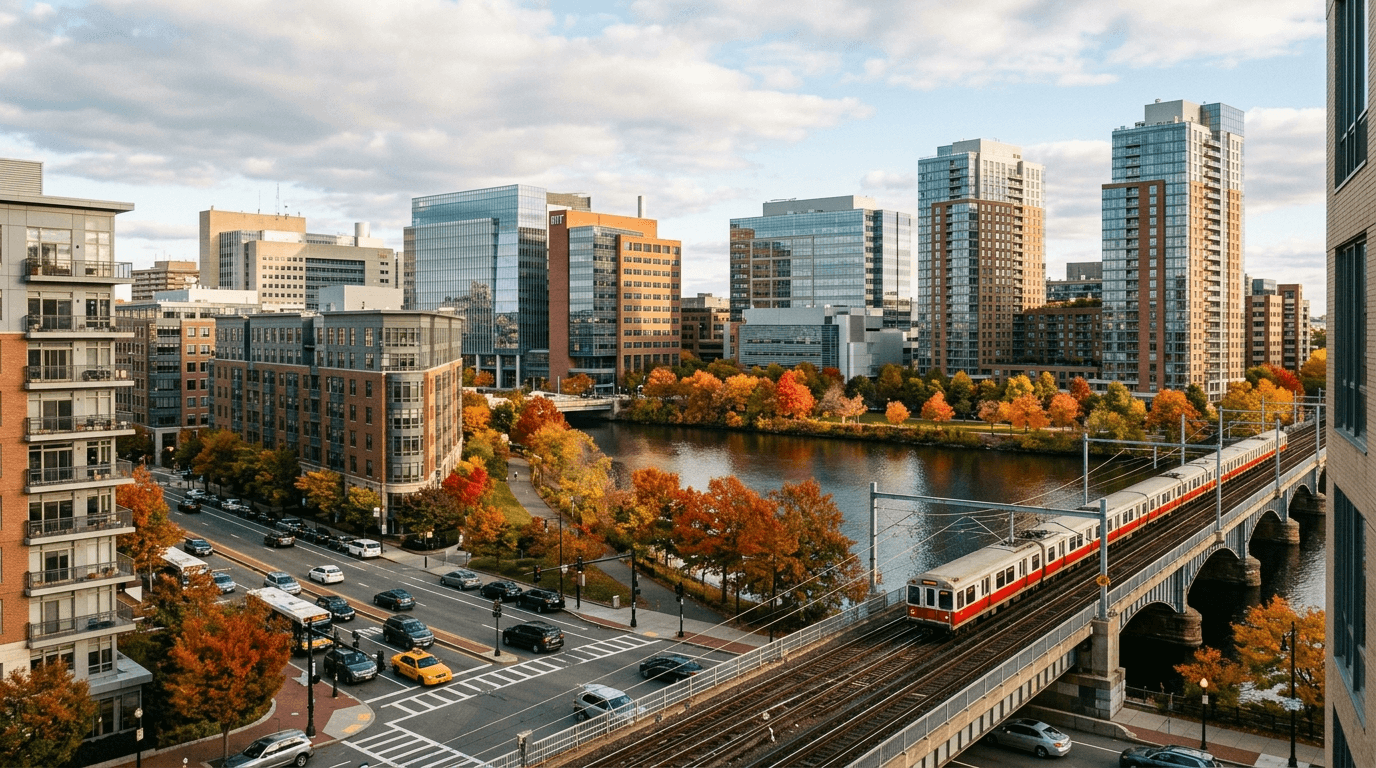
Living in Cambridge, MA: The Essential Guide for Young Professionals
Urban, intellectual Cambridge guide: $866K median condos, 6.3 months supply, Red Line access, and Harvard/Central/Kendall square lifestyles.
Written ByAndrew Schwartz
PublishedSeptember 9, 2026
We're SmartHub Boston, a data-driven brokerage led by Andrew Schwartz serving buyers, sellers, investors and landlords across Boston, Cambridge, Newton and Brookline. Serving Boston, Newton, Brookline, Cambridge, Somerville, Watertown, Natick, Wellesley and Weston, MA.
Cambridge, MA
Region
# Living in Cambridge, MA: A Neighborhood Guide for Young Professionals
There aren't many places in the country where you can leave your apartment, order a coffee behind two people arguing about CRISPR delivery mechanisms, and still be at your desk in a Kendall Square lab — or a downtown Boston office — inside of twenty minutes. Density, intellect, transit. For young professionals, that's the entire pitch.
What follows is what it actually feels like to live here, what it costs, where people gather, and how you'll get around.
What is the vibe like in Cambridge, MA?
Cambridge is urban, fast-moving, and intellectually charged — closer to a dense city than a suburb, with roughly 116,000 residents packed into just over six square miles. Busy is the default setting. That said, there are pockets of real quiet in the residential side streets tucked between the squares.
Two institutions and one industry set the tempo. Harvard and MIT anchor a full-time student population of around 42,000, which means the sidewalks never fully empty and the calendar runs on academic rhythms. September brings a noticeable surge. Late August is moving-truck chaos.
The other engine is the innovation economy. Greater Boston and Cambridge host roughly 1,000 biotech and tech companies, and Cambridge's office market has historically been the tightest and most expensive in the region, with asking rates running well above Boston's. That's what happens when this much demand concentrates into a handful of square miles. When I'm showing condos near Kendall or East Cambridge, a meaningful share of buyers are relocating for a lab, a startup, or a venture fund.
Day to day, here's how that plays out:
•Never dull, rarely calm. Streets stay active well into the evening, especially around Central and Harvard.
•Extremely diverse. Cambridge consistently ranks among the most educated cities in the U.S., and the restaurant scene reflects a genuinely international resident base — Ethiopian at Asmara , Korean groceries at H Mart , and a coffee shop culture where people actually linger.
•Progressive and pedestrian-first. The city runs a 23-member Pedestrian Committee, a Vision Zero program, and speed limits capped at 25 mph citywide (20 mph on most standard streets). You feel it in how the streets are designed.
•Green relief exists. Roughly 70–80 parks and open spaces citywide, so even on the densest blocks you're rarely more than a few minutes from grass.
If you're weighing Cambridge against the quieter western suburbs, be honest with yourself about noise, foot traffic, and parking. Cambridge trades tranquility for access. Most young professionals who move here decide that's the right trade.
What are condos and townhomes like in Cambridge, MA?
Condos and townhomes are the dominant ownership path in Cambridge — as of July 2026, the median condo/townhouse sale price was $866,611, with a median 36 days on market and 6.3 months of supply across 366 active listings. That's a materially different market from the detached-home tier.
Cambridge July 2026 Market Snapshot: Condo/Townhouse Reality Check
A high-level read for young professionals weighing a Cambridge condo purchase: pricing sits below single-family territory, but inventory and time-on-market show a market with more choice than the spring rush.
The gap between property types is the single most important thing a first-time buyer here needs to understand. Single-family homes carried a median sold price of $2,225,000 as of July 2026, with 33 median days on market and just 4.4 months of supply across 85 active listings. Multi-families sat in similar territory — a median of $2,180,000 as of June 2026, with only 11 active listings and 3.4 months of supply.
Median Sold Price by Cambridge Property Type
Single-family and multi-family homes remain in the $2M+ tier, while condos/townhouses offer the most approachable ownership lane for urban buyers who want Cambridge access without detached-home pricing.
Single-family and multi-family homes remain in the $2M+ tier, while condos/townhouses offer the most approachable ownership lane for urban buyers who want Cambridge access without detached-home pricing.
Plainly: if you want to own in Cambridge on a young-professional income, you're almost certainly buying a condo. That's not a consolation prize. Condos are the default urban housing product here, and they account for a large share of the city's dwelling units.
What architectural styles will you actually see in Cambridge, MA?
The housing stock is a layer cake, and each layer prices differently.
•Converted two- and three-family homes. The workhorse of the Cambridge condo market. Wood-frame New England multi-families carved into 2–4 units, often with original details, bay windows, and back porches. You'll find them throughout Mid-Cambridge, Cambridgeport, Inman, and North Cambridge.
•Victorian townhomes and brick row houses. Concentrated around Harvard Square, Brattle Street, and pockets of Mid-Cambridge. Beautiful, character-heavy, occasionally quirky in layout.
•Modern and luxury high-rises. Clustered in East Cambridge, Kendall Square, and along the NorthPoint/Cambridge Crossing corridor. Elevators, doormen, gyms, garage parking — and the monthly fees that come with all of it.
•New-construction boutique buildings. Increasingly common as the zoning environment loosens, which I'll get to below.
What are lot sizes like in Cambridge, MA?
Small, and that's rather the point. Cambridge's residential zoning is dominated by Residence C-1 (roughly 3,299 acres), and the city was largely built out before the automobile reshaped American lot standards. Parcels are compact. Outdoor space is usually a shared yard, a deck, or a roof right. Dedicated parking is a genuine amenity, not an assumption.
For anyone working long hours, that compactness tends to be a feature. Lock-and-go ownership means no lawn, no driveway to shovel, and an association handling the roof.
What do HOA fees and carrying costs look like in Cambridge, MA condos?
Budget realistically. Condo fees generally run from around $250/month in simple self-managed associations up to $700+/month in amenity-rich elevator buildings with concierge service, fitness centers, and garages.
The offsetting good news is the tax bill. Cambridge property taxes are remarkably low for the region — the FY2026 residential rate is $6.67 per $1,000 of assessed value, which works out to roughly $5,800/year at the median condo price. Compared with most Greater Boston municipalities, that's real monthly savings, and many buyers don't factor it in until we run the numbers side by side.
Two practical notes from the offer table: earnest money deposits here typically run 2–3% or more, and closing windows usually land in the 30–60 day range.
How much inventory is actually available in Cambridge, MA?
Condos aren't just the most affordable segment. They're the deepest one.
Active Listings by Cambridge Property Type
Condo/townhouse inventory dominates the available market, which matters for young professionals prioritizing walkability, transit access, and lower-maintenance ownership options.
Condo/townhouse inventory dominates the available market, which matters for young professionals prioritizing walkability, transit access, and lower-maintenance ownership options.
With 366 active condo/townhouse listings against 85 single-family and 11 multi-family, a condo buyer simply has more shots on goal. Pair that with 6.3 months of supply as of July 2026 and you get more room to be selective than buyers had during the frenzied spring cycles of recent years.
Will Cambridge, MA build more housing?
Yes — and this is the structural story most buyers underweight. Effective February 2025, Cambridge overhauled its residential zoning in a way few American cities have attempted.
Cambridge Residential Zoning Changes: More Urban Density by Right
Effective February 2025, Cambridge’s zoning overhaul allows more multifamily housing in residential neighborhoods, removes parking requirements, and creates added height incentives tied to affordability—key context for future supply near jobs, transit, and amenities.
Multi-family HousingAllowed in all residential neighborhoods
Multi-family housing is now allowed in all residential neighborhoods, with a standard height limit of 4 stories, no density or unit cap, and no parking requirement. Projects can reach 6 stories with conditions, including a 20% affordable set-aside, and affordability requirements trigger at 10 or more units or 10,000 sqft of gross floor area.
For a buyer, that means two things. Expect new supply over the coming years, particularly on larger parcels near transit and commercial corridors. And recognize that the older triple-decker condo you're considering sits on land with meaningfully more development optionality than it had two years ago.
What are the best squares and social hubs in Cambridge, MA?
Cambridge is organized around "squares" rather than a single downtown — Harvard, Central, Kendall, Inman, Porter, and Davis-adjacent North Cambridge each function as their own commercial and social center. Choosing where to live is largely a question of which square you want to be able to walk to.
What is Harvard Square in Cambridge, MA like?
The historic heart of the city, and the one visitors know. Street performers in the Pit, bookstores, the Crimson Galeria and The Garage for retail, plus a dense concentration of cafes. Housing nearby skews historic townhomes and higher-priced condos, and West Cambridge and the Brattle Street area sit at the top of the city's pricing tiers.
Best for: buyers who want prestige, walkability, and historic architecture — and who have the budget to pay for it.
Why do young professionals pick Central Square in Cambridge, MA?
The cultural engine. Live music venues, an unmatched range of global cuisine, real nightlife, and the most unpolished energy in the city. The Cantab Lounge is a Cambridge institution. Life Alive handles the lunch rush. The Central Square branch of the Cambridge Public Library is a genuinely good remote-work spot. Central also sits at the geographic middle of the city, which makes it strategic if your social life spans both Harvard and Kendall.
Best for: young professionals who want nightlife and Red Line access at a better price per square foot than Harvard.
What is it like to live in Kendall Square in Cambridge, MA?
It's been called "the most innovative square mile on the planet," and the numbers support the concentration — Sanofi alone recently committed to 900,000 SF at 350 & 450 Water Street. Post-work life revolves around rooftop bars, food halls, and the plazas between lab buildings. The housing is the newest in the city: glass towers, elevator buildings, full amenity packages.
Best for: biotech and tech workers who want a walking commute and would rather not think about maintenance.
Is Inman Square in Cambridge, MA still attainable?
The neighborhood locals guard. Restaurants, coffee, and a village-y scale sitting between Central and East Cambridge. It's frequently cited as one of the last relatively attainable pockets in the city — though "attainable" in Cambridge is a relative term.
Best for: buyers who want character and community over amenity buildings.
What is living in East Cambridge actually like?
Old brickwork, new towers, and the water. Close to Kendall, close to the Museum of Science and the Charles, and home to much of the city's newest condo inventory near Cambridge Crossing. Formaggio Kitchen Kendall is the neighborhood's not-so-secret provisions stop.
Best for: buyers prioritizing new construction and Kendall proximity.
How is the commute from Cambridge, MA to Boston?
Cambridge sits directly on the MBTA Red Line, which puts Downtown Crossing and South Station roughly 10–20 minutes away from most of the city — and driving into Boston typically runs about 15 minutes off-peak. For most young professionals here, a car is optional.
Which MBTA stations serve Cambridge, MA?
The Red Line runs the spine of the city, hitting four stops in sequence:
•Kendall/MIT — the biotech corridor; one stop to Charles/MGH, two to Park Street.
•Central — the most central and most bus-connected station in the city.
•Harvard — the busiest hub, with a major bus terminal underneath.
•Porter — Red Line plus Commuter Rail (Fitchburg Line), which matters if your job or family is out toward Waltham, Concord, or Fitchburg.
Alewife anchors the northwest end with a large parking garage, useful if you occasionally need to drive and park before hopping the train. The Green Line Extension has also brought Somerville stops within easy reach of North Cambridge and Inman-adjacent addresses.
Bus service is dense, particularly the routes fanning out of Harvard Square, and the 1 bus runs Massachusetts Avenue straight across the river into Boston.
Is Cambridge, MA good for biking and walking?
Cambridge has invested heavily here, and the trajectory is steep. The city's PeopleForBikes City Rating climbed from 36 in 2020 to 72 in 2024, following the Cycling Safety Ordinance, which targets roughly 25 miles of protected bike routes with a completion goal of 2026. Cambridge ranks 6th in Massachusetts and 40th in New England on that same rating.
The network detail tells a more nuanced story, though.
Cambridge Bike Network Access Scores
For a car-light urban lifestyle, Cambridge scores strongest for retail and recreation access, while transit-hub connectivity and resident access are the weaker points to pressure-test by neighborhood.
Network Score50/100
People (Access to residents)36/100
Opportunity (Access to jobs/schools)51/100
Core Services (Access to basic needs)43/100
Recreation (Access to parks/trails)60/100
Retail (Access to shopping)74/100
Transit (Access to hubs)35/100
For a car-light urban lifestyle, Cambridge scores strongest for retail and recreation access, while transit-hub connectivity and resident access are the weaker points to pressure-test by neighborhood.
Retail access scores highest at 74, with recreation access at 60 — so errands and rides out to the Charles River paths are genuinely doable on two wheels. Transit-hub access (35) and access-to-residents (36) score lower, which reflects a protected network that's still filling in unevenly across neighborhoods.
My practical advice: don't buy on the citywide score. Ride the specific route between your prospective address and your office on a weekday morning before you sign anything. The difference between a block with a protected lane and one without is significant here.
Bluebikes stations are dense across all of the squares, and walkability is excellent throughout the core. The city's Five-Year Streets and Sidewalks Plan has been steadily adding raised crosswalks, pedestrian ramps, and crossing enhancements.
What about driving and parking in Cambridge, MA?
Highway access is good. Route 2 feeds into Alewife and the northwest corridor, Memorial Drive runs the length of the Charles, and I-90 (the Mass Pike) is a quick hop across the river via the BU Bridge or Storrow.
Parking is the harder problem. Garage rates run roughly $15–$30 per day, resident permits are required on most streets, and thanks to the 2025 zoning changes, new buildings carry no parking requirement at all. If you own a car and plan to keep it, treat a deeded space as a must-have line item rather than a nice-to-have. Deeded parking in Cambridge holds value in a way it doesn't in most markets.
Who should buy in Cambridge, MA right now?
Cambridge rewards buyers who know what they're optimizing for. If the answer is a big yard and a quiet cul-de-sac, the western suburbs will serve you better and cost less per square foot. If the answer is living car-light, walking to a lab or a Red Line platform, and being surrounded by people building interesting things, there's no substitute in Greater Boston.
The current condo market offers something buyers haven't consistently had: choice. As of July 2026, 6.3 months of supply and a 36-day median time on market in the condo segment mean you can tour thoroughly, run your numbers, and negotiate without being stampeded. That's a genuinely different posture from the spring cycle.
A few things I'd tell any young professional starting a Cambridge search:
1. Underwrite the full monthly, not the price. Condo fee plus the $6.67 per $1,000 tax rate plus insurance. Cambridge's low tax rate can make a higher purchase price pencil better than a comparable home in a neighboring city.
2. Read the condo docs seriously. Reserve levels, deferred maintenance on century-old buildings, and pending special assessments are where deals go sideways in this housing stock.
3. Pick your square before you pick your unit. Harvard, Central, Kendall, Inman, and East Cambridge are genuinely different lifestyles at genuinely different price points.
4. Factor the zoning change into your five-year view. More by-right density near your block cuts both ways — more future supply, but also more optionality if you ever sell to a developer.
Cambridge isn't a market you win on gut feel. You win it by knowing which block, which building, and which month you're competing in.
Local Spots & Favorites
Cambridge Market Statistics
Median sale price, days on market, and closed sales by property type.
Is Cambridge, MA a good place to live for young professionals?
Cambridge, MA is urban, dense, intellectually driven, and highly transit-oriented. Young professionals are drawn to its Red Line access, walkable squares, biotech and tech job concentration, and active restaurant, coffee, and nightlife scenes.
Is Cambridge, MA family-friendly?
Cambridge, MA offers roughly 70–80 parks and open spaces, strong walkability, and a pedestrian-focused street design approach. The city has a Pedestrian Committee, a Vision Zero program, and speed limits capped at 25 mph citywide, with 20 mph limits on most standard streets. Families should still expect an urban environment with noise, foot traffic, and limited parking.
How much do condos and townhomes cost in Cambridge, MA?
As of July 2026, the median condo and townhouse sale price in Cambridge, MA was $866,611, with a median 36 days on market. Condos and townhomes are the main ownership path for many buyers because single-family homes had a much higher median sold price of $2,225,000.
What are condo HOA fees like in Cambridge, MA?
Cambridge, MA condo fees generally range from about $250 per month in simple self-managed associations to $700 or more per month in amenity-rich elevator buildings. Buildings with concierge service, gyms, garages, and other amenities usually have higher monthly fees.
Is Cambridge, MA affordable for first-time buyers?
Cambridge, MA is expensive, but condos provide the most attainable ownership option compared with single-family and multi-family homes. As of July 2026, the condo and townhouse segment had 366 active listings and 6.3 months of supply, giving buyers more choice than in the smaller single-family and multi-family markets.
How is the commute from Cambridge, MA to Boston?
Cambridge, MA has strong access to Boston through the MBTA Red Line, with Downtown Crossing and South Station roughly 10–20 minutes away from most of the city. Driving into Boston typically takes about 15 minutes off-peak, but many residents can live car-light because of transit, biking, and walkability.
Do you need a car in Cambridge, MA?
A car is optional for many Cambridge, MA residents because the city has Red Line stations at Kendall/MIT, Central, Harvard, and Porter, plus dense bus service and Bluebikes stations across the squares. Parking is limited, resident permits are required on most streets, garage rates run about $15–$30 per day, and deeded parking is a valuable amenity.
What should buyers know about schools and education in Cambridge, MA?
Cambridge, MA is strongly shaped by higher education, with Harvard University and MIT anchoring a full-time student population of around 42,000. The city is consistently ranked among the most educated cities in the U.S., and its academic calendar affects local rhythms, especially during the September move-in surge.