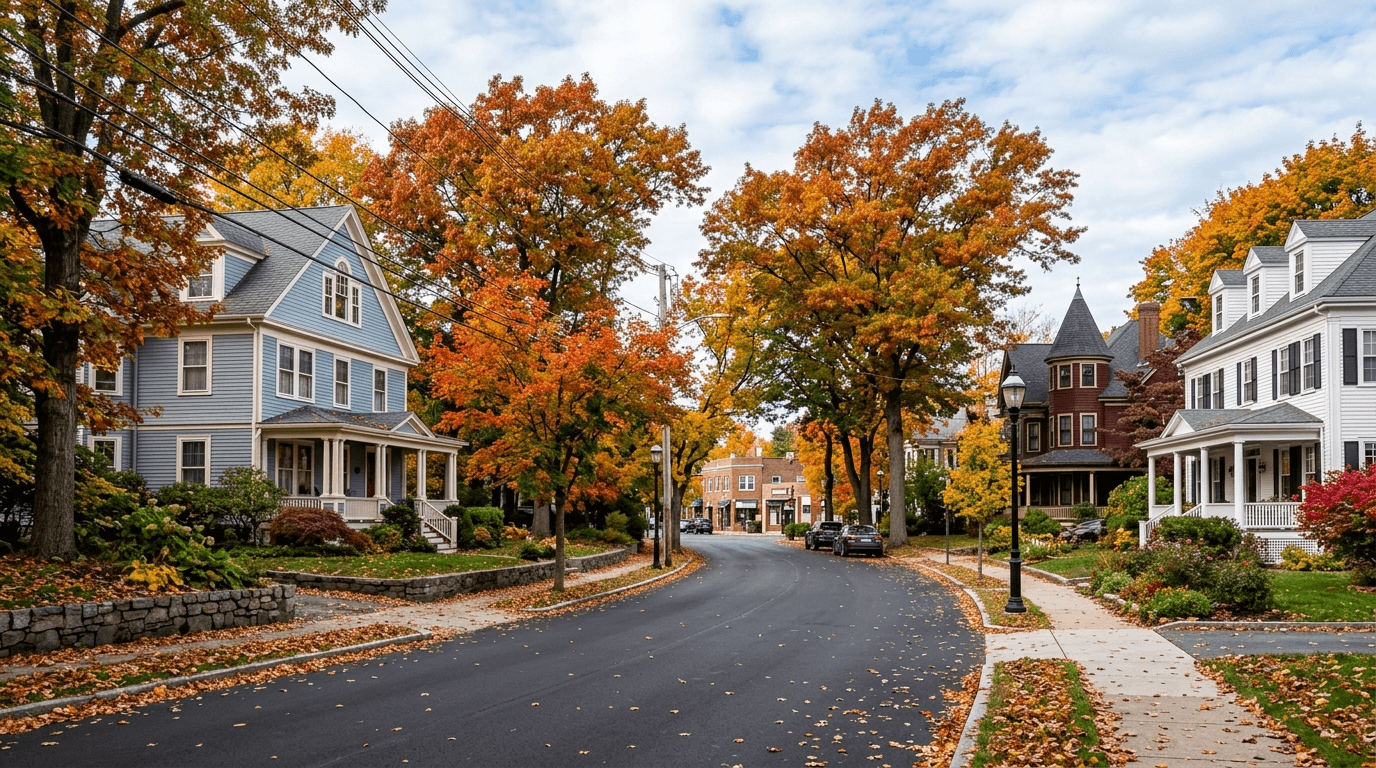
Newton, MA Neighborhood Guide: The Ultimate Suburb for Growing Families
Explore Newton’s 13 villages, 11,461-student public schools, Green Line D Branch, Commuter Rail, parks, and July 2026 home prices.
Written ByAndrew Schwartz
PublishedSeptember 9, 2026
We're SmartHub Boston, a data-driven brokerage led by Andrew Schwartz serving buyers, sellers, investors and landlords across Boston, Cambridge, Newton and Brookline. Serving Boston, Newton, Brookline, Cambridge, Somerville, Watertown, Natick, Wellesley and Weston, MA.
Newton, MA
Region
# Newton, MA Neighborhood Guide: The Ultimate Suburb for Growing Families
If you're house hunting in the middle of a school year, you're not alone. Newton has a funny way of holding onto people — families move here planning to stay five years and somehow it turns into twenty-five. What follows is the on-the-ground version: the streets, the schools, the playgrounds, the train, and what daily life actually feels like once you've unpacked.
Is Newton, MA a Good Place to Raise a Family?
Yes — Newton is consistently one of the strongest family choices in Greater Boston, thanks to a nationally regarded public school system, low-traffic residential streets, and a village structure that keeps neighborhoods small and personal even though the city itself holds roughly 88,000 residents.
The thing most buyers don't expect is that Newton doesn't feel like one city at all. It feels like thirteen small towns that happen to share a mayor. Newton Centre, Newtonville, West Newton, Waban, Auburndale, Newton Highlands, Chestnut Hill, Nonantum, Upper Falls, Lower Falls, Newton Corner, Oak Hill, and Thompsonville — each one has its own coffee spot, its own elementary school, its own rhythm.
With young kids, that structure changes everything. Your world gets small in the best possible way: the walk to the elementary school, the playground where the same eight families turn up every Saturday morning, the pizza place where the owner already knows your kid's order.
What families tell us they notice first:
•Quiet, tree-canopied side streets. Step off the village centers and the arterials — Beacon, Centre, Walnut, Washington — and the residential streets are genuinely calm. Sidewalks are almost universal, which matters more than people expect once you're pushing a stroller every single day.
•Strong school outcomes. Newton Public Schools serves 11,461 students district-wide (2025–26), with 100% full-day kindergarten and a graduation rate around 97%.
•Active neighborhood culture. Village associations, PTOs, youth sports leagues, and a packed seasonal calendar do a lot of the social heavy lifting for you. Newcomers get folded in fast.
Newton Family-Move Snapshot: Housing, Schools & Transit
Headline numbers for young families evaluating Newton: premium home prices, strong school outcomes, and close-in Boston access.
One practical note if you're shopping for September 2026: the district approved a $314.5 million FY27 budget, a 5.75% increase over FY26. Even so, rising salary and health care costs meant roughly $3.8M in staffing reductions were needed to balance it. There were real trade-offs — central office roles were trimmed by about $2.7M — while 8 middle school math interventionist positions were added. Newton's schools remain excellent, and budget conversations are a genuinely active part of civic life here. Sit in on a School Committee meeting or two and you'll understand this town faster than any brochure will explain it.
Which Newton, MA Villages Are Best for Young Families?
For families with elementary-age kids, Newtonville, West Newton, Auburndale, Newton Highlands, and Waban tend to be the sweet spot — walkable to a village center, walkable to a school, and spread across a wide enough price band that there's usually something workable.
•Newtonville & West Newton — the most "walk everywhere with a stroller" villages in the city. Great Harvest of Newtonville is the sort of place where you'll bump into three families you know on a Saturday morning.
•Waban & Newton Highlands — quieter, leafier, Green Line access, very family-dense.
•Auburndale — riverside and tucked away, with a Commuter Rail stop and a long history as one of the better value plays.
•Newton Centre & Chestnut Hill — the most amenity-rich, and generally the priciest.
•Nonantum & Upper Falls — the entry points, with tighter lots and a strong, deeply rooted community identity.
Buyers coming from Brookline or Cambridge almost always say the same thing: Newton trades urban density for yard space and quiet. Buyers arriving from further west — Natick, Framingham — notice they've bought back twenty minutes of their day.
What Kinds of Homes Are Available in Newton, MA, and What Do They Cost?
Newton is overwhelmingly a single-family market — Colonials, Victorians, Tudors, Capes, and mid-century ranches on lots that typically run from about 6,000 to 15,000+ square feet. As of July 2026, the median single-family sale price in Newton was $1,807,500, with a median 41 days on market and 4.2 months of supply across 217 active listings.
That inventory figure deserves a pause. Four-plus months of single-family supply is a far more breathable market than the frantic spring rushes Newton has seen in past cycles. Homes are still selling. But buyers finally have room to inspect, sleep on it, and negotiate.
Attached housing tells a different story. As of July 2026, Newton condos had a median sale price of $875,000, also 41 days on market, with 6.3 months of supply across 182 active listings. That's a real buyer's-market cushion — and it's exactly where a lot of first-time Newton families get their foothold, especially in two- and three-bedroom units in Newtonville, Upper Falls, and Nonantum.
Across all property types as of July 2026, the median sat at $1,660,000, with 442 active listings and 5.4 months of supply.
Newton Quarterly Median Price Trend
Quarterly median sale prices from Q2 2025 through Q2 2026 show Newton’s single-family market remaining materially higher than the condo market, with Q2 2026 single-family pricing reaching $2.09M quarter-to-date.
Median (all)
SF median
CC median
Quarterly median sale prices from Q2 2025 through Q2 2026 show Newton’s single-family market remaining materially higher than the condo market, with Q2 2026 single-family pricing reaching $2.09M quarter-to-date.
How Does Newton, MA Pricing Compare to Nearby Towns?
Newton lands in the upper tier of the western suburbs, though not at the very top — below Brookline and Wellesley, above Needham, and well above Watertown.
Newton vs. Neighboring Markets: 2026 Median Single-Family Prices
A regional price comparison showing Newton positioned below Brookline and Wellesley, above Needham, and well above Watertown for single-family homes.
A regional price comparison showing Newton positioned below Brookline and Wellesley, above Needham, and well above Watertown for single-family homes.
Where Newton quietly wins is the tax line. The FY2026 residential rate is $9.69 per $1,000 of assessed value, down from $9.80 in FY2025 and comfortably below the Massachusetts statewide average of roughly $12.18. On a $1.5M assessment, that works out to about $14,535 a year, or $1,211 a month. Set that next to Wellesley ($10.17), Needham ($10.83), Lexington ($12.31), or Watertown ($12.20), and you can see how Newton's split-rate structure — commercial property carries $18.06 — does real work for homeowners. First-half bills are due November 1, second-half May 1.
What Should Families Know About Newton, MA Architecture and Renovations?
Newton's housing stock is old and beautiful, which cuts both ways. Here's what to expect:
•Classic exteriors, modernized interiors. The most competitive family listings are the ones where a previous owner already knocked out the kitchen-to-family-room wall and finished a basement playroom. Untouched 1920s Colonials trade at a discount — and for a family willing to renovate, that discount is the opportunity.
•Generous, usable backyards. This is the single biggest lifestyle upgrade families mention when they move out from Brookline, Brighton, or Cambridge. Flat, fenceable yards are common, especially in Waban, Oak Hill, and West Newton.
•A new design constraint worth knowing about. Effective March 1, 2026, Newton's Residential Facade Build Out Ratio caps a home's front elevation width at 60% of lot frontage. City Council passed it 18–5, with exemptions for lots under 50 feet wide and additions under 1.5 stories, and it's slated for review in March 2027. If you're eyeing a teardown or a big front-facing addition, this changes what's buildable. One more thing: any structure 50+ years old triggers historic review before demolition.
•New construction is scarcer than it was. Residential new-construction permits fell to 56 in FY2024 ($56.0M in value), down from 98 in FY2023 ($162.5M). Fewer builder homes means the ones that do hit the market draw a crowd.
Where Do Families Actually Gather in Newton, MA?
Newton's social life happens in three places: the parks, the village centers, and the library. There's no single downtown — and that's exactly why the community feels so neighborly and spread out in a good way.
Crystal Lake (Newton Centre) is the summer anchor. The city beach opens for swimming, families kayak and paddleboard, and on warm evenings the lawn fills up with blankets and picnic dinners. Buy near Crystal Lake and plan on June through August revolving around it.
Cold Spring Park is the year-round workhorse: playgrounds, ball fields, cross-country trails through the woods, and a seasonal farmers market that functions as a kind of unofficial town meeting. On a fall Tuesday, half the neighborhood is there.
Beyond those two, there's Bullough's Pond for a stroller loop and skating in a hard freeze, Newton Centre Playground for the toddler crowd, and Edmands Park for families who want real woods inside city limits. The Charles River path through Auburndale and Lower Falls is a favorite for bikes and beginner runners alike.
The village centers are where the errands and the ice cream happen:
•Newton Centre — the largest, with boutiques, bookstores, restaurants, bakeries, and Green Line access. Rancatore's is the post-soccer ritual for a lot of families.
•West Newton — walkable, independent-minded, with a beloved cinema and easy Commuter Rail access.
•Newtonville — the most everyday-practical of the bunch: groceries, pharmacy, bakery, pizza, all within a few blocks.
•Newton Highlands — small, charming, and extremely walkable from the surrounding streets.
And don't sleep on the Newton Free Library . It's genuinely one of the best public libraries in the state — story hours, teen programming, museum passes, and a parking lot full of minivans every rainy Saturday. Get a card your first week here.
How Is the Commute from Newton, MA to Boston and Cambridge?
Newton sits about 7 miles from downtown Boston with three separate rail options and immediate highway access — the main reason working parents choose it over towns further west.
MBTA Green Line, D Branch (Riverside Line). Seven Newton stops — Riverside, Woodland, Waban, Eliot, Newton Highlands, Newton Centre, and Chestnut Hill — take you straight to Fenway, Copley, Park Street, and Government Center with no transfer. It's a trolley, so it's slower than the Commuter Rail, but it runs frequently and it drops you in the heart of the city. Riverside also has a large parking garage, which makes it the practical pick for families who need to drive to the train.
MBTA Commuter Rail, Framingham/Worcester Line. Stops in Newtonville, West Newton, and Auburndale get you to South Station in roughly 15–20 minutes when the schedule cooperates. For downtown and Seaport professionals, nothing in the city is faster.
One important caveat if you're shopping Newtonville right now: the station is slated for a full accessibility rebuild — two 400-foot, fully accessible, bidirectional platforms — and it will close for roughly 28 months during construction. Work is expected to begin around November/December 2026, with completion projected for June 2029. The project budget has grown from $50 million to $66 million. Newtonville sees about 300 daily boardings today, so riders will shift over to West Newton, and buyers nearby should plan on a temporary walk or drive to an alternate stop.
$50 millionOriginal Budget
Newtonville Commuter Rail Station Accessibility Improvements
A major transit infrastructure project families should track: Newtonville station is slated for a full accessibility overhaul, with a 28-month closure and projected completion in June 2029.
My honest read: short-term pain, long-term gain. A fully accessible, bidirectional Newtonville station is a meaningful upgrade for a village that's already among Newton's most walkable. Buy nearby in 2026 and you're buying just ahead of the improvement rather than paying a premium for it.
Driving and highways. The Massachusetts Turnpike (I-90) has Newton on-ramps at Newton Corner and Route 128/Weston, and Route 128/I-95 runs along the city's western edge. That combination is why Newton works so well for two-career households — one parent heading downtown, the other out to Waltham, Burlington, Needham, or the 128 corridor. Route 9 handles the Brookline/Longwood run, and Cambridge is an easy shot via Route 16 or the Pike.
Bus and school transportation. Several MBTA bus routes — the 59, 52, 553, 554, and 556 among them — link village centers to Watertown, Waltham, and Newton Corner. Newton Public Schools provides bus service, though plenty of elementary families simply walk. That's a real quality-of-life win when you're wrangling two kids and two backpacks before 8 a.m.
What's the Bottom Line for Families Considering Newton, MA in Fall 2026?
Newton asks a lot financially, and it gives a lot back: schools that outperform state averages by wide margins, thirteen villages that each function like their own small town, a park and library system that would be the pride of a much bigger city, and three rail options into Boston.
For fall 2026 buyers, there's more breathing room in this market than there was a couple of years ago. 4.2 months of single-family supply and 6.3 months of condo supply — both as of July 2026 — mean inspections, contingencies, and honest negotiation are back on the table. The families who do best here are the ones who get specific early: pick your two or three villages, confirm the elementary school assignment for any address you're serious about, and understand how the new facade rules affect the renovation you're already dreaming about.
If you can spare a Saturday morning to walk a few villages and feel the difference between Waban and Newtonville, do it. That's the best hour you'll spend on this whole search. The neighborhoods explain themselves once you're standing in them.
Local Spots & Favorites
Newton Market Statistics
Median sale price, days on market, and closed sales by property type.
Yes. Newton, MA is one of Greater Boston’s strongest family-oriented suburbs, with a nationally regarded public school system, quiet tree-canopied residential streets, near-universal sidewalks, and a village structure that keeps neighborhoods feeling small and personal.
The city has roughly 88,000 residents across thirteen villages, each with its own local rhythm, schools, parks, and village center. Families often value the combination of walkable neighborhoods, active PTOs, youth sports, village associations, and strong community routines.
How good are the schools in Newton, MA?
Newton Public Schools is a major reason many families choose Newton, MA. The district serves 11,461 students for the 2025–26 school year, offers 100% full-day kindergarten, and has a graduation rate of about 97%.
The schools remain highly regarded, though budget discussions are an active part of local civic life. The FY27 school budget was approved at $314.5 million, a 5.75% increase over FY26, while staffing reductions were still required to balance rising costs.
Which Newton, MA villages are best for young families?
Newtonville, West Newton, Auburndale, Newton Highlands, and Waban are often strong fits for families with elementary-age children because they combine walkability, access to village centers, and neighborhood schools. Newtonville and West Newton are especially practical for stroller-friendly errands and daily routines.
Waban and Newton Highlands are quieter, leafier, and served by the Green Line. Auburndale has a tucked-away riverside feel and Commuter Rail access, while Newton Centre and Chestnut Hill offer more amenities at generally higher prices.
Are condos and townhomes available in Newton, MA for families?
Yes. While Newton, MA is primarily a single-family home market, condos and townhomes are an important entry point for many first-time Newton buyers, especially two- and three-bedroom units in Newtonville, Upper Falls, and Nonantum.
As of July 2026, Newton condos had a median sale price of $875,000, a median 41 days on market, 182 active listings, and 6.3 months of supply. That level of condo supply gives buyers more room to compare options and negotiate than in tighter markets.
How much does it cost to buy a home in Newton, MA?
As of July 2026, the median single-family sale price in Newton, MA was $1,807,500, with a median 41 days on market and 4.2 months of supply across 217 active listings. Across all property types, the median sale price was $1,660,000, with 442 active listings and 5.4 months of supply.
Newton is priced in the upper tier of Boston’s western suburbs, below Brookline and Wellesley, above Needham, and well above Watertown. The FY2026 residential property tax rate is $9.69 per $1,000 of assessed value.
Is Newton, MA more affordable than nearby suburbs?
Newton, MA is not a low-cost suburb, but its pricing sits below Brookline and Wellesley while remaining above Needham and well above Watertown. Buyers comparing high-performing western suburbs often weigh Newton’s home prices against its schools, commute options, village centers, parks, and residential tax rate.
The FY2026 residential tax rate is $9.69 per $1,000 of assessed value, below the Massachusetts statewide average of roughly $12.18. On a $1.5 million assessment, that equals about $14,535 per year, or about $1,211 per month.
How is the commute from Newton, MA to Boston?
Newton, MA is about 7 miles from downtown Boston and has three main rail options: the Green Line D Branch, the Framingham/Worcester Commuter Rail, and nearby highway access. The Green Line serves Riverside, Woodland, Waban, Eliot, Newton Highlands, Newton Centre, and Chestnut Hill with direct service toward Fenway, Copley, Park Street, and Government Center.
The Commuter Rail stops in Newtonville, West Newton, and Auburndale and can reach South Station in roughly 15–20 minutes when the schedule cooperates. Drivers also have access to the Massachusetts Turnpike, Route 128/I-95, Route 9, and Route 16.
What should families know about transportation changes in Newtonville, MA?
The Newtonville Commuter Rail station is scheduled for a full accessibility rebuild with two 400-foot, fully accessible, bidirectional platforms. Construction is expected to begin around November or December 2026, with completion projected for June 2029.
The station is expected to close for about 28 months during construction, so riders will need to use alternatives such as West Newton or other nearby options. The project budget increased from $50 million to $66 million, and the station currently has about 300 daily boardings.